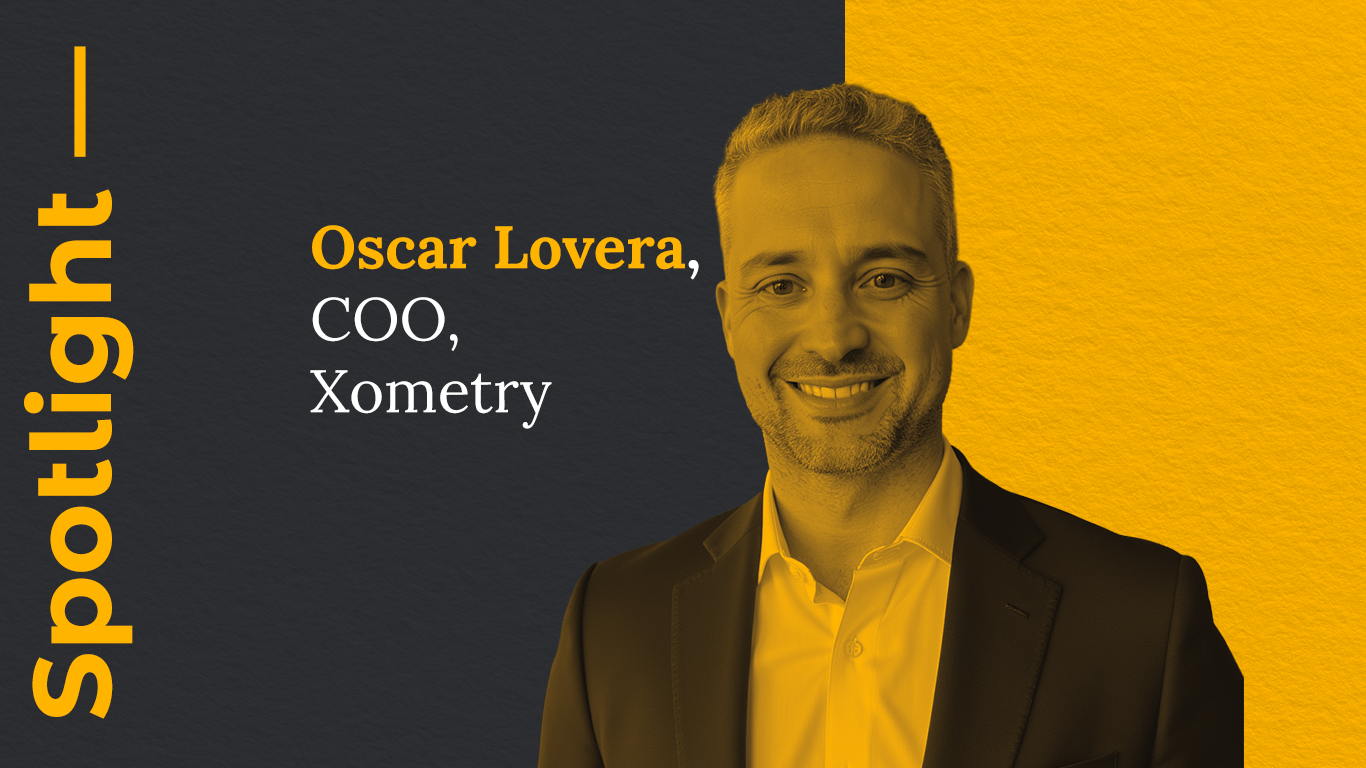
Manufacturing has always depended on precision, but digital marketplaces add another layer of complexity: they must create precision across dispersed partners, variable lead times, different quality standards, and increasingly high customer expectations. For Oscar Lovera, Chief Operating Officer at Xometry, that challenge sits at the centre of the role.
His career has moved across manufacturing, consulting, and ecommerce, but a consistent thread runs through each chapter. At Procter & Gamble, he says, “my job wasn’t to push for more output — it was to ensure the system was stable”. The lesson was practical and immediate: maintain the machines, keep processes centred, and make sure operators are equipped to deliver. “When the system works, the product makes itself,” he says.
That early grounding in operational discipline was followed by a shift in perspective at McKinsey & Company, where Lovera moved from the realities of a single site to the challenges facing entire organisations. The most durable lesson from that period, he says, was the need to define the right problem before trying to solve it. At Wayfair, he saw another side of scale, with digital platforms, cross-border operations, and data-led coordination helping to modernise a fragmented sector. Xometry, in his telling, brings those experiences together: manufacturing discipline, strategic clarity, and digital scale in one model.
Building controlled growth —
When Lovera describes operational excellence, he does so in deliberately unsentimental terms. “Operational excellence, to me, is the ability to consistently deliver predictable, high-quality outcomes at scale — not through heroics, but through well-designed systems,” he says. In a business where precision and speed both matter, that distinction is important. He is less interested in one-off interventions than in repeatable performance.
At Xometry, the complexity comes in layers. The platform serves multiple industries, technologies, and regulatory environments, while also relying on a global manufacturing network with different capabilities, costs, and lead times. The harder task, Lovera suggests, is making that complexity perform consistently.
His answer has been to focus on the operating backbone. That means common standards, quality frameworks, performance management, and local leadership, while leaving room for regional and process-specific differences. It also means using automation and data visibility to reduce manual touchpoints and intervene earlier when something starts to drift.
The phrase he returns to is “controlled growth”. Xometry is not simply trying to add volume, but to build a model that can support a smaller innovator and a global enterprise with the same discipline. In a marketplace business, that also requires balance. “A marketplace only works if both sides win,” he says, pointing to the need to align customers and manufacturing partners, improve feedback loops, and build long-term trust.
Leading through noise —
The shift from large incumbents to faster-moving platform businesses also changed how Lovera thinks about leadership. In more established environments, he learned the value of structure, governance, and standards. In consulting and tech-led marketplaces, the demands were different: more ambiguity, faster decision-making, and a greater need to shape systems rather than simply work within them.
That has altered the balance in his leadership style. Earlier in his career, he says, performance was closely tied to standards and management control. Over time, particularly in scaling environments, he came to see that “sustainable growth requires building leaders”. In practice, that means setting direction clearly, then giving teams enough ownership to execute.
The same thinking informs his approach to digital transformation. One line from the interview stands out because of how plainly it is put: “technology does not fix broken processes.” For Lovera, transformation starts with process clarity, standards, and ownership. Only then does technology become useful. He is equally direct about the human side of change. Tools alone do not deliver adoption; teams need to understand the purpose of the change, trust the data, and feel accountable for the outcome. Sequencing matters as well. Trying to digitise everything at once, he argues, creates fatigue rather than momentum.
A consulting assignment early in his career appears to have sharpened those instincts. Working with a steel company on the brink of bankruptcy, amid political scrutiny and media pressure, he watched a senior leader resist the surrounding noise. “Zone out the noise. That’s context. There is a problem to solve,” she told the team. The experience stayed with him. Under pressure, his instinct now is to create structure: clarify the problem, define ownership, anchor decisions in data, and move deliberately.
That mindset also shapes his view of the next generation of operational leaders. Manufacturing, he notes, has already lived through several waves of disruption, from automation and lean to globalisation and supply chain digitisation. AI and digitisation matter, but they do not remove the need for judgement. Future leaders, in his view, will need to separate noise from structural change, stay anchored in fundamentals, and build organisations that can learn without losing discipline. The technologies will keep changing. The operating principles, he suggests, are harder to replace.
This piece first appeared in the Q1 2026 edition of Business Quarter magazine. Click here to read.