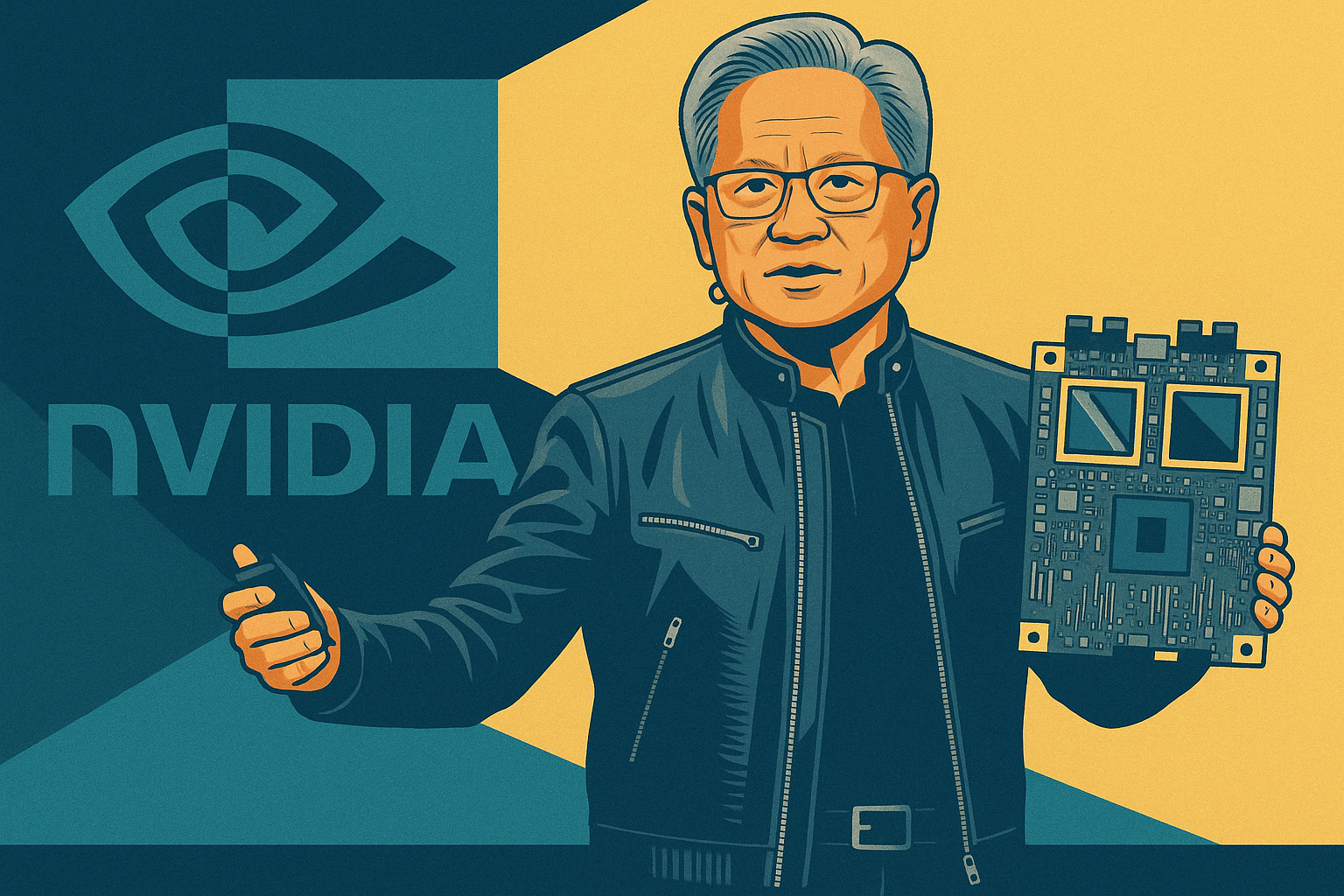
Nvidia has made history as the first company to surpass a $5 trillion market valuation, capping an extraordinary two-year ascent powered by the artificial-intelligence boom. The chipmaker’s share price closed at $207.04 on 29 October 2025, lifting its market value to $5.03 trillion, according to Reuters.
The milestone cements Nvidia’s transformation from a specialist graphics-processor designer into the central engine of the AI economy. Its chips now underpin most major generative-AI platforms and data-centre architectures, positioning the company at the heart of a rapidly expanding ecosystem of developers, cloud providers, and governments.
Since the launch of ChatGPT in late 2022, Nvidia’s shares have risen more than twelve-fold. The company passed the $4 trillion threshold barely three months ago. Investors have continued to drive the stock higher as demand for AI-optimised computing power outpaces supply and new competitors struggle to match its efficiency.
“Nvidia hitting a $5 trillion market cap is more than a milestone; it’s a statement,” said Matt Britzman, senior equity analyst at Hargreaves Lansdown, in comments to China Daily Asia. “Nvidia has gone from chip maker to industry creator.”
The company’s order backlog has reportedly climbed to around $500 billion, with plans under way to build seven government-sponsored supercomputers in the United States. Chief executive Jensen Huang’s personal stake in the business is now estimated at $179 billion, placing him among the world’s wealthiest individuals.
Nvidia’s valuation surge underscores investor confidence in the global AI race, but it also amplifies scrutiny of whether earnings growth can sustain such momentum. Analysts note that price-to-earnings multiples now far exceed those of past technology booms, heightening sensitivity to any slowdown in orders or margins.
The company’s dominance has drawn attention from policymakers as well as markets. US export restrictions on advanced chips to China have made Nvidia’s products a flashpoint in geopolitical technology competition. Its hardware sits at the intersection of national security, economic growth, and the emerging regulatory frameworks governing AI use.
Nvidia will release its next quarterly results on 19 November. Investors will be watching whether revenue figures align with expectations built into this record valuation — and whether the world’s most valuable company can maintain its pace of innovation amid intensifying competition.
For global markets, Nvidia’s ascent signals both the power and the concentration of the AI era. As hardware, software, and data converge, the question is not only how high valuations can climb, but how durable this new technological order will prove.