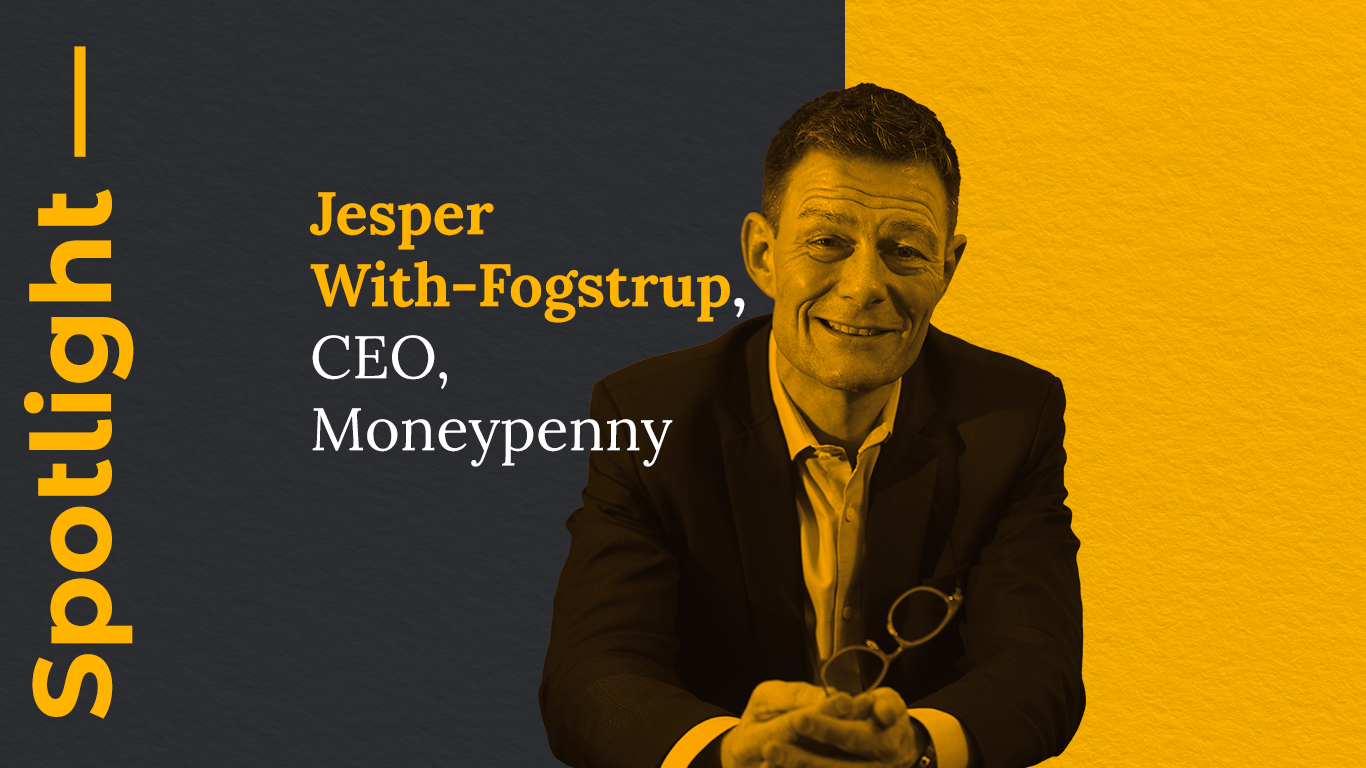
From travel and hospitality to finance and communications tech, Jesper With-Fogstrup has built a leadership approach around removing obstacles, backing teams, and keeping customers at the centre of change. Now, as CEO of Moneypenny, he is trying to show that AI can sharpen service, strengthen trust, and support growth without pushing people to the margins.
As businesses continue to experiment with AI, the most pressing leadership question is no longer whether the technology can improve efficiency. It is whether those gains can be achieved without weakening customer trust, flattening company culture, or making employees feel as though they are being managed by systems rather than supported by them.
That tension sits at the centre of Jesper With-Fogstrup’s leadership at Moneypenny. In a market increasingly crowded with promises of faster response times, better data, and more personalised communication, his argument is that technology should remove friction, not remove people. The job of leadership, in that context, is to make change usable, credible, and human.
It is an argument shaped by a career that has moved across sectors, but remained rooted in one consistent theme. Before taking the helm at Moneypenny, With-Fogstrup built his experience across travel, hospitality, finance, and communications technology. Different industries, certainly, but in his account the constant has always been the same: customers remember how they are treated, and teams perform best when they are trusted, supported, and given room to do meaningful work.
That helps explain why he describes his role less as command and control, and more as creating the conditions for others to succeed. He often refers to himself as the “Chief Unblocking Officer”, a phrase that captures both the tone and discipline of his leadership. The point is not to step into every process, but to remove barriers so people can move with more confidence and clarity.
Leadership built around people —
With-Fogstrup’s leadership style is not presented as an abstract philosophy. It comes through as a practical response to complexity. Moving between industries has, he says, made him more adaptable and more curious, but it has also reinforced a simpler lesson: while products, systems, and market pressures may change, people’s motivations do not. Trust, purpose, and ownership still matter.
That is visible in how he talks about teams. At Moneypenny, autonomy is important, but so is connection. He speaks about giving people the freedom to innovate while ensuring they remain supported and tied to a common mission. In other words, flexibility is not the same as detachment. Leadership, in this model, requires both room to move and a clear sense of why the work matters.
That balance becomes more important during periods of rapid transformation. Plenty of organisations talk about becoming more digital, but many struggle with the human consequences of that change. New systems are introduced, workflows shift, expectations rise, and employees are left trying to interpret what the change means for them. It is often at that point that strategy begins to fray.
With-Fogstrup’s view is that leaders make this harder when they frame transformation as a technology project. “Transformation is never just about technology. It’s about mindset,” he says. People need to understand why change is happening, feel able to test and learn, and trust that experimentation will not be punished. That creates a very different atmosphere from one in which innovation is announced from the top and absorbed under pressure.
He is equally direct about the role of the leader inside that process. Rather than presenting certainty at all times, he argues for openness. He says he does not believe in pretending to have every answer, and instead tries to build a culture in which solutions are explored together. That approach may sound modest, but it has sharp operational consequences. It shifts leadership away from performance theatre and towards communication, transparency, and shared problem-solving.
Technology should widen, not narrow, the human role —
If there is one idea that runs through With-Fogstrup’s account of Moneypenny’s strategy, it is that AI should sit alongside human judgement, not attempt to replace it. He describes the company’s philosophy as “human brilliance, powered by technology”, and the phrase is useful because it avoids the usual binary. The point is not to choose between people and systems, but to be clear about which work each is best placed to do.
In his framing, AI is best used for repetitive, administrative, and analytical tasks — the work that can consume time without adding much human value. What should be protected, and even expanded, is the part of service that relies on empathy, interpretation, and relationship-building. Those are the moments clients tend to remember, and the moments that are hardest to automate well.
That distinction matters because many businesses still adopt technology in the wrong sequence. They start with the tool, then work backwards to culture and service. With-Fogstrup suggests the opposite order. At Moneypenny, he says, tools are introduced with employees in mind, feedback is gathered early, and the test is whether technology makes work more rewarding rather than more complicated. It is a small but meaningful shift in emphasis. Efficiency still matters, but not at any cost.
What emerges is a more disciplined definition of responsible AI adoption. It is not enough for a system to work technically. Leaders also have to consider how it changes the employee experience, how it alters customer expectations, and whether it strengthens or weakens trust in the service itself. That is why With-Fogstrup returns repeatedly to the idea of balance: let technology do the heavy lifting, but keep warmth, understanding, and creativity in human hands.
The same logic shapes his view of wellbeing. During periods of expansion or technological change, employee wellbeing is often discussed as a parallel issue — important, but separate from performance. With-Fogstrup rejects that split. “Wellbeing and performance go hand in hand,” he says. If people do not feel supported in an inclusive environment, he argues, no growth strategy or technology rollout will fix the deeper problem.
That is not framed as a soft benefit. It is framed as a business requirement. Flexible working, open communication, and time for personal growth are all presented as part of the operating model rather than as perks around the edge of it. His shorthand for the principle is equally plain: “If we look after our people, they’ll look after our clients.” In service businesses, where customer experience depends so heavily on the quality of human interaction, that is less slogan than mechanism.
Growth without losing cultural identity —
Scaling a business adds another layer of pressure. It is one thing to define a culture at a single site or within a single market. It is another to preserve its core characteristics as teams expand across geographies, customer expectations diversify, and local norms begin to shape daily practice. Many companies try to solve that by standardising everything. With-Fogstrup’s answer is more nuanced.
“Culture doesn’t scale automatically; you have to nurture it deliberately,” he says. At Moneypenny, that has meant staying anchored to core values — care, curiosity, and courage — while allowing regional teams to express those values in their own way. The distinction matters. A company can insist on shared standards without assuming that every office should look, sound, and operate in exactly the same way.
That is where one of his most useful lines arrives. “Consistency doesn’t mean uniformity. It’s about shared purpose, not identical practices.” For leaders overseeing growth across borders, that is a pragmatic test. Cultural strength is not proved by sameness. It is proved by whether teams in different markets can still recognise themselves as part of the same organisation, even when local conditions shape how the work is done.
With-Fogstrup points to exchange between Moneypenny’s UK and US teams as one way of maintaining that connection. By bringing people together across markets, the company is not simply sharing methods. It is reinforcing context, relationships, and mutual understanding. For international businesses, that kind of investment often matters more than another layer of process documentation. It gives culture a lived dimension, rather than leaving it as a set of words on a presentation slide.
All of this leads to the question that now sits ahead of many leaders working with AI: trust. With-Fogstrup describes it as the biggest challenge, but also as a major opportunity. As tools become more sophisticated, customers and employees increasingly want clarity over when AI is being used, when a person is involved, and how data is handled. That demand for transparency is unlikely to fade. If anything, it will become a baseline expectation.
For Moneypenny, the ambition is clear. With-Fogstrup says he wants the company to set the standard for what “human + AI” looks like when it is done well — frictionless and personalised for clients, and talent-amplifying for employees. It is a forward-looking vision, but also a disciplined one. The company should remain a place where people are proud to work, he says, and where innovation serves humanity, rather than the other way around.
That is also the advice he offers to other leaders. Start with the problem you are trying to solve. Involve your teams early. Move in measurable steps. Stay transparent about what you are learning. Keep humans in the loop, and keep values in view. Or, as he puts it more bluntly, “AI is a tool, not a strategy.”
It is a line that lands because it strips away some of the noise now surrounding adoption. Tools matter, certainly, but leadership still determines whether they are deployed with care, credibility, and useful restraint. For businesses trying to work out what responsible AI looks like in practice, With-Fogstrup’s position is straightforward enough to be tested: use technology to make service richer, work more rewarding, and trust easier to sustain. If that balance holds, the gains are likely to be more durable than efficiency alone.
This piece first appeared in the Q1 2026 edition of Business Quarter magazine. Click here to read.