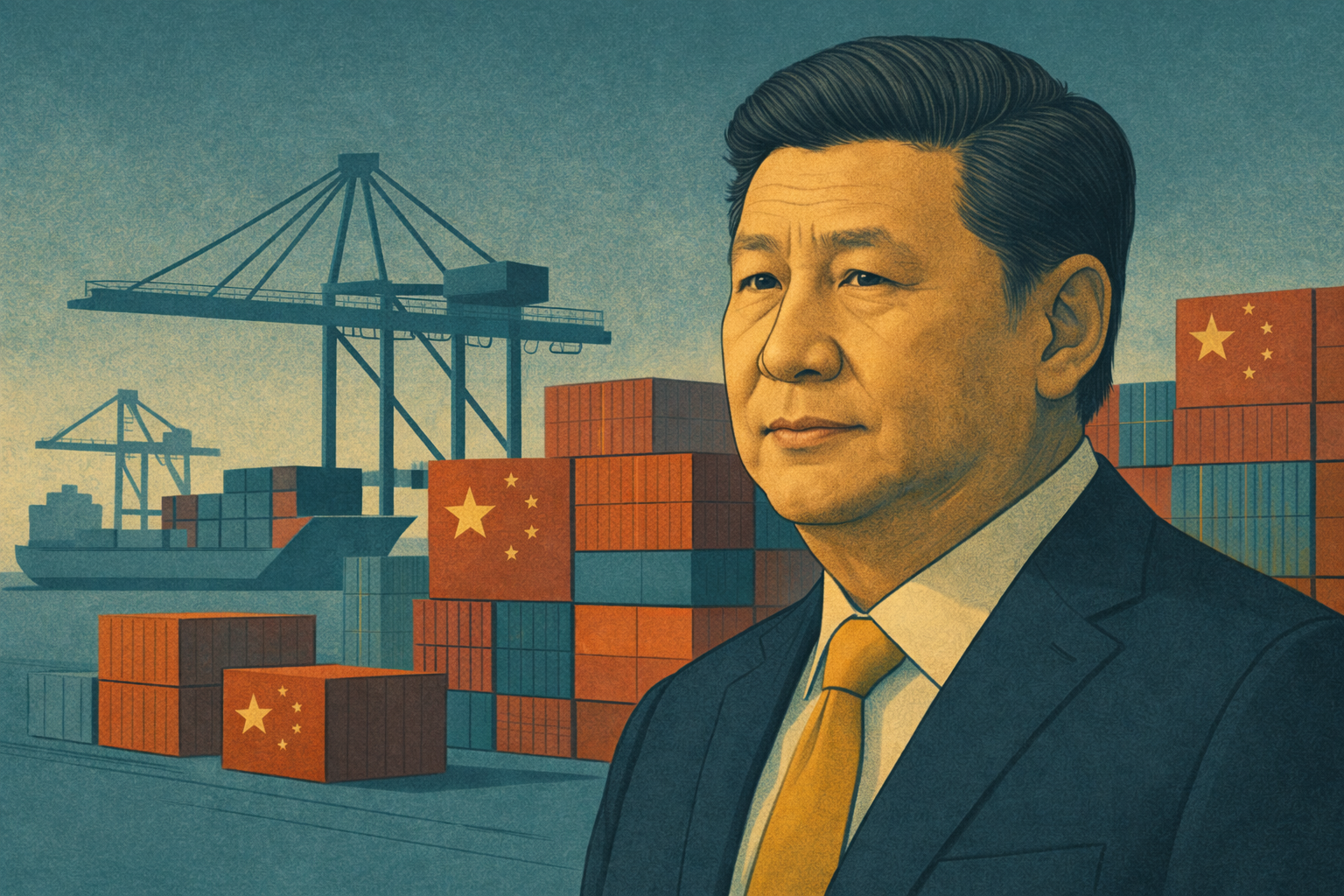
China’s full-year trade data, released by the General Administration of Customs, showed the world’s second-largest economy posting a surplus of about $1.19 trillion — its highest ever and the first to exceed the $1 trillion mark. December exports rose 6.6 per cent year-on-year, while imports climbed 5.7 per cent, underscoring both external resilience and uneven domestic demand.
“China’s export sector has adapted faster than expected to shifting trade conditions,” said Hao Zhou, chief economist at Guotai Jun’an International in Hong Kong. “Diversification into new markets helped cushion the U.S. shock.”
Exports to the United States fell roughly 20 per cent over the year after Washington reinstated higher tariffs on Chinese electric vehicles, semiconductors, and selected industrial components. Yet shipments to emerging markets surged. Exports to Africa grew around 25.8 per cent, to ASEAN by 13.4 per cent, and to the European Union by 8.4 per cent, according to customs data.
The composition of exports also shifted markedly. Electric vehicle sales abroad jumped nearly 49 per cent in 2025, cementing China’s position as the world’s largest auto exporter for a third consecutive year. Electronics and other high-value manufactured goods continued to underpin total trade growth.
Economists note that China’s ability to sustain exports despite tariff headwinds reflects deep-rooted supply-chain integration and competitive pricing. However, analysts warn the model remains unbalanced. Imports — often seen as a proxy for domestic demand — have recovered only partially amid ongoing weakness in the property sector and muted consumer sentiment.
“The trade numbers highlight the resilience of China’s external sector, but also the fragility of internal demand,” said Wendy Chen, senior economist at Commerzbank AG. “Rebalancing toward consumption will be essential if growth is to stabilise.”
Policy officials in Beijing have signalled an intent to sustain open-trade policies while reducing reliance on export subsidies. The Commerce Ministry said in a statement that China would “continue deepening economic cooperation with developing countries” and “promote diversified, mutually beneficial trade structures.”
Globally, the record surplus has reignited debate over imbalances in the world economy. The IMF has urged China to accelerate reforms aimed at boosting domestic consumption, while several trading partners — including the EU and India — have flagged the competitiveness of China’s currency as a potential distortion.
China’s 2025 trade performance highlights three dynamics. First, export-market diversification can offset geopolitical shocks more effectively than protectionist policies can suppress them. Second, tariff exposure remains a structural risk for supply chain planners. And third, the enduring gap between China’s export capacity and its domestic demand presents both vulnerabilities and openings — particularly for global consumer and services brands positioned to benefit if household confidence returns.
China’s foreign-trade outlook for 2026 will depend on how far tariff measures extend under Washington’s new trade posture and whether domestic stabilisation efforts gain traction. For now, the record surplus marks a milestone in both scale and strategic adaptability — a reminder that the centre of global manufacturing remains firmly anchored in China, even amid renewed geopolitical turbulence.