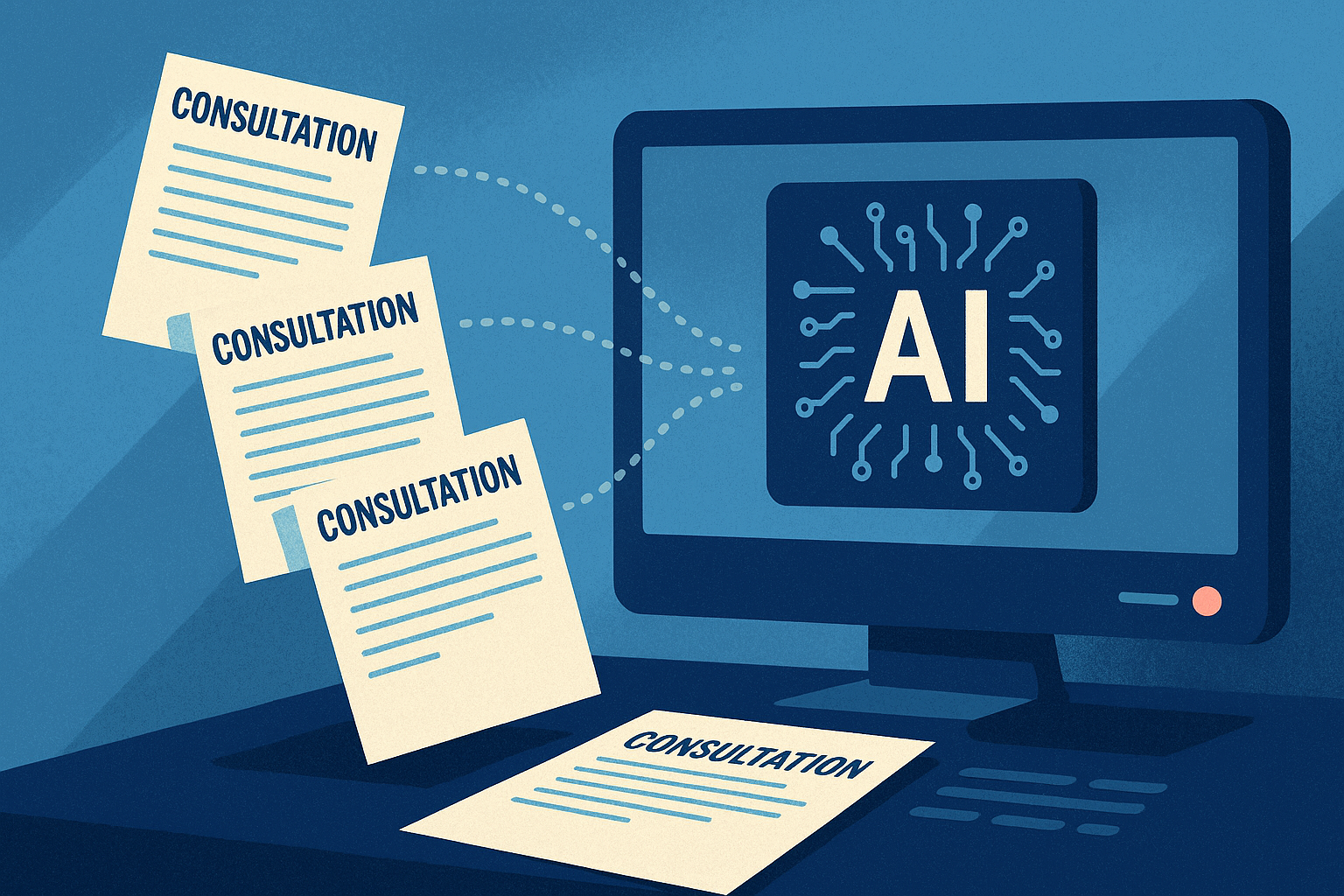
The UK government has begun trialling a new AI tool designed to automate the process of reviewing and summarising public consultation responses. Named ‘Consult’, the tool is part of a wider suite of machine learning initiatives known informally as ‘Humphrey’, intended to modernise policy administration and free up civil service capacity.
In one of its early trials, the Scottish Government deployed Consult to review over 2,000 responses to a consultation on the regulation of non-surgical cosmetic procedures. The AI analysed themes across submissions, producing a rapid first draft summary that was then validated by human analysts. The Cabinet Office claims that the tool can work up to 1,000 times faster than manual methods, with a projected 400x cost efficiency gain.
Government estimates suggest that rolling out the system across all departments could save as much as £20 million annually and free up around 75,000 hours of civil servant time across the 500 consultations conducted each year.
Technology Secretary Peter Kyle described the AI deployment as a way to reduce the “cost of governing” while still improving how the public and experts can contribute to government policy. He also suggested that it could reduce consultation fatigue by making feedback more visible and meaningful in decision-making processes.
But alongside the enthusiasm, caution remains. Experts have warned that AI systems applied in policymaking must be rigorously tested for bias and manipulation. Professor Michael Rovatsos from the University of Edinburgh noted that even with human oversight, poorly designed or inadequately trained models could amplify systemic inequalities or obscure minority views in consultation feedback.
The launch forms part of a broader government strategy to integrate AI into public services. A separate report commissioned by Microsoft and Goldsmiths, University of London, estimates that AI could save up to 23 million hours of administrative work per week across the UK public sector, with the greatest efficiencies realised in tasks involving paperwork, case handling, and document classification.
The ‘Consult’ tool will remain in trial across several departments before wider rollout is confirmed later in 2025. Observers say the success of such tools may rest less on technical performance and more on public trust in how machine learning is used in sensitive, democratic processes.