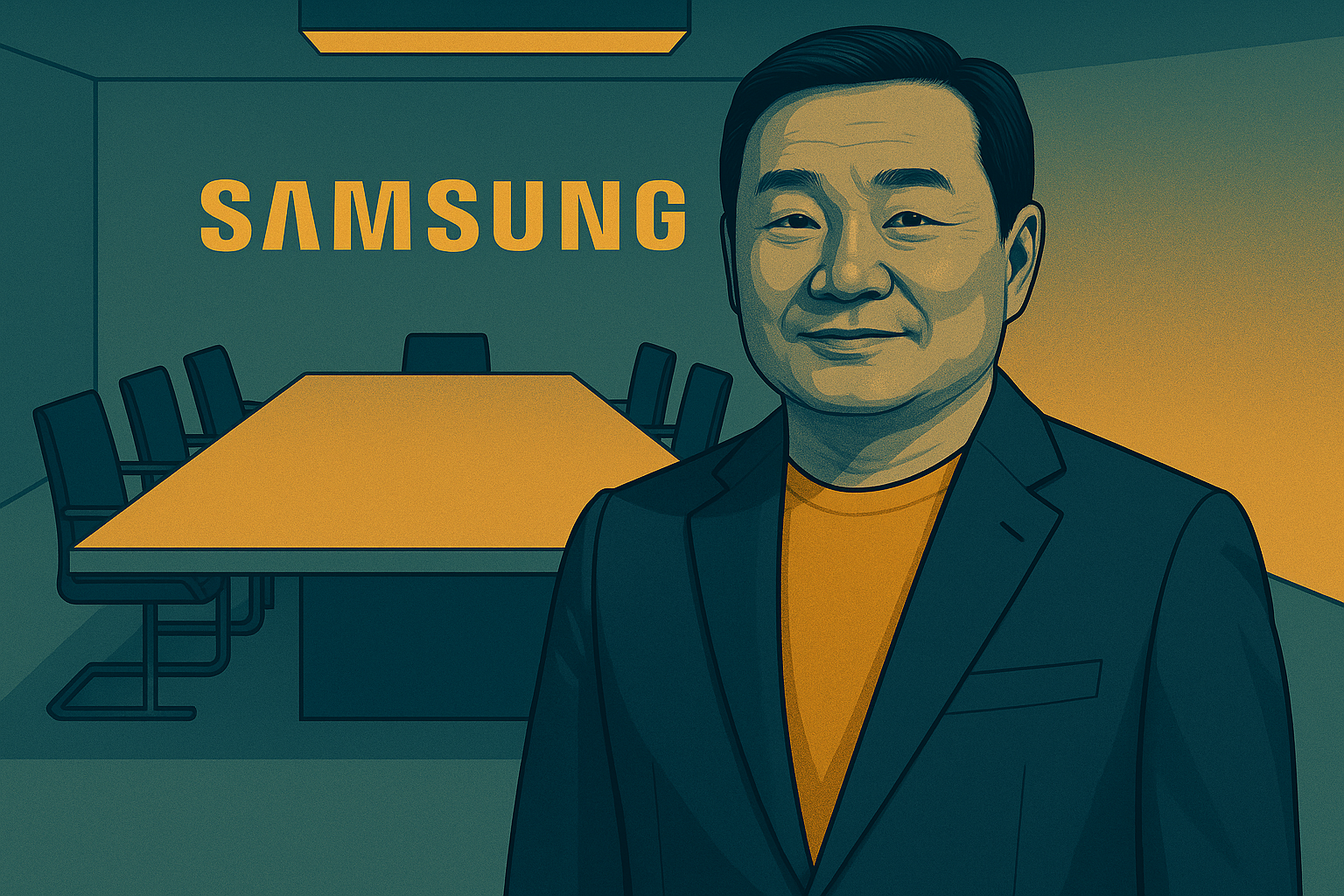
Samsung Electronics has returned to a two-headed leadership model, appointing its mobile chief Roh Tae-moon (TM Roh) as co-CEO while maintaining Jun Young-hyun at the helm of its semiconductor division. The announcement marks a shift back to the governance structure that once defined the South Korean company’s balance between consumer technology and components.
Roh, who has led Samsung’s Mobile eXperience (MX) business since 2020, will oversee the wider Device eXperience (DX) division covering smartphones, televisions, and appliances. Jun Young-hyun, a veteran of Samsung’s memory operations, will continue to head the Device Solutions (DS) division, responsible for semiconductors and displays.
In a statement released on Friday, Samsung said the appointments are intended to “strengthen technology leadership and drive sustained innovation” across its two main business engines. The move follows the death of Han Jong-hee, Samsung’s former consumer-electronics co-chief, in March 2025. Roh had served as acting head of the DX division since April.
Analysts described the decision as a pragmatic step designed to reinforce stability at a time of uneven market conditions. “It’s a predictable but strategically sound move,” one Seoul-based analyst told Reuters, noting that the return to dual leadership allows both divisions to focus on execution as the company navigates demand shifts in smartphones and memory chips.
Samsung’s shares fell around 4 percent on the day of the announcement, broadly in line with weakness across Asian technology markets. Investors viewed the leadership change as continuity rather than overhaul, reflecting the company’s preference for steady management during cyclical headwinds.
The dual-CEO structure mirrors the model Samsung maintained for most of the 2010s, which allowed independent decision-making in its consumer and semiconductor arms. That arrangement was dissolved in 2022 under a consolidation led by Han Jong-hee. By reinstating it, Samsung is signalling a return to operational clarity as competition intensifies in foldable devices, artificial-intelligence integration, and high-density memory production.
Roh’s elevation comes at a time when the company’s mobile business faces renewed pressure from Apple and Chinese rivals, while its memory unit contends with global price volatility and investment in AI-optimised chips. Analysts expect the twin-chief structure to facilitate faster product cycles and closer coordination between component design and consumer hardware.