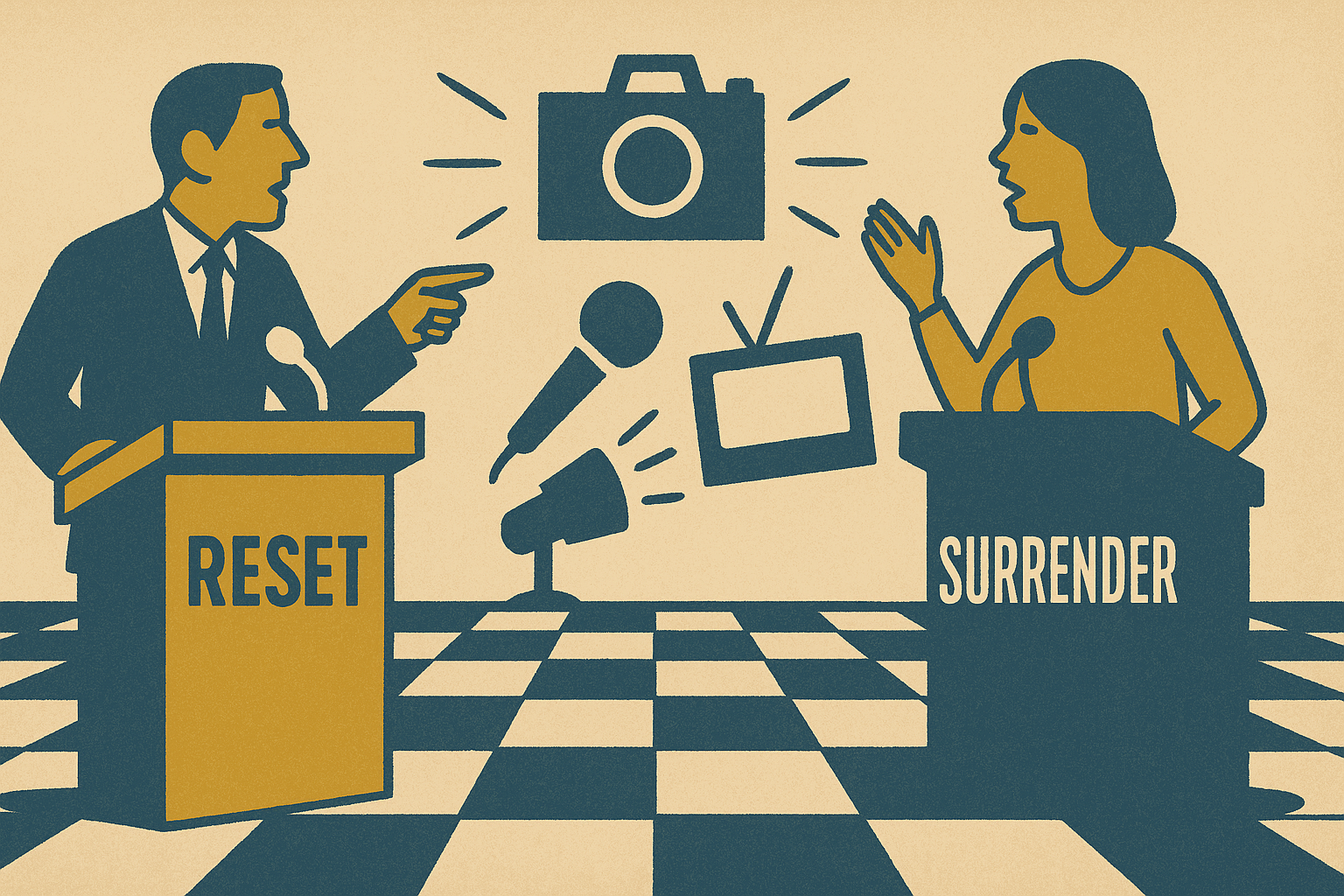
When Prime Minister Keir Starmer and European Commission President Ursula von der Leyen announced the UK-EU “reset,” the focus was on pragmatic cooperation: easing border checks, aligning carbon costs, and reducing trade friction. The government’s messaging emphasised progress and maturity.
However, opposition voices quickly reframed the agreement as a “surrender,” invoking emotive language that resonated with segments of the public. Reform UK leader Nigel Farage lambasted it as “an abject surrender”, stating: “The whole ‘reset’ is an abject surrender from Starmer and politically something he will come to regret.” Meanwhile, Conservative leader Kemi Badenoch argued: “This deal is taking us to the past and that is why we call it surrender,” warning it would leave Britain “a rule taker”.
This divergence in narratives underscores the power of framing in shaping public perception — a principle well-known in political theory and increasingly vital in business communication.
Framing theory, as articulated by cognitive linguist George Lakoff, argues that the metaphors and mental structures used to present a message shape how that message is received. As Lakoff himself puts it, “Unless you frame yourself, others will frame you — the media, your enemies, your competitors, your well-meaning friends.”
Fundamentally, if it’s a ‘reset’, cooperation sounds wise. If it’s a ‘surrender’, then even compromise feels like failure.
Simon Phillips, a business transformation expert and host of The Change Show, summarises this well and sees it reflected in Starmer’s strategy: “When leaders face tough choices, the narrative framework they employ often determines stakeholder reception and implementation success.
“Keir Starmer’s approach to the UK-EU ‘reset’ demonstrates this principle. Faced with improving EU relations while not appearing to undermine Brexit, Starmer needed to reframe the conversation.”

Polling data supports this framing battleground. While a May 2025 YouGov poll showed that only 29% of respondents viewed the new deal as good for the UK — compared to 26% who viewed it negatively and 30% who were unsure — support for specific measures like the youth mobility scheme reached 65%. The facts of the deal remained static; what changed was the lens through which they were viewed.
For marketers, the lesson is clear. Framing must come early, clearly, and consistently. Emma Grant, Co-Director at Figment, explains: “Allowing others to define the narrative first is risky. It cedes control and can amplify misinformation, polarise opinion, and erode trust.”
She continues: “Framing begins with acknowledging the complexity and impact of the decision honestly, while clearly articulating the purpose and long-term benefits. Leaders who position the change as part of a bigger vision, aligned with shared values, create a stronger emotional connection with their audience.”
Phillips agrees: “The most powerful framing doesn’t sell a decision; it creates the space for people to own it.” He contrasts two real-world examples: a professional services firm that “maintained 87% employee engagement through the transition” by contextualising restructuring as industry evolution, and a charity that framed post-COVID office closures as cost-cutting — a choice that “sparked resistance and questions about other potential cuts.”
Done well, narrative framing turns difficult changes into accepted realities. Poorly handled, it amplifies backlash and undermines trust. For businesses managing layoffs, rebrands, price rises or crises, the principles remain the same: name your strategy early, speak to emotion as well as fact, and maintain discipline in voice and tone.