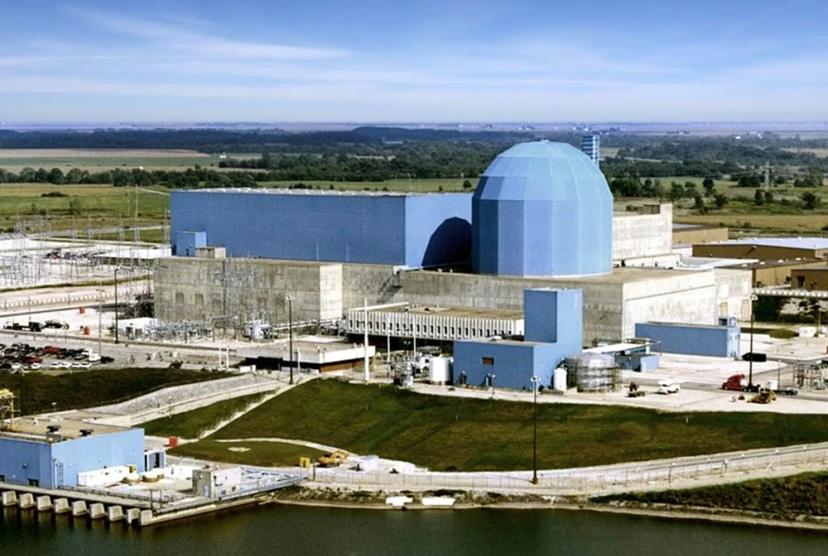
Meta, the parent company of Facebook, Instagram, and WhatsApp, has announced a new agreement with Constellation Energy to extend the operational life of a nuclear energy facility in Illinois by 20 years. The facility’s 1.1 GW output will support Meta’s operations in the region and contribute to the company’s clean energy targets.
Starting in June 2027, the agreement will enable the Clinton Clean Energy Center in DeWitt County, Illinois to receive relicensing, allowing it to continue operations for an additional 20 years. Initially commencing commercial service in 1987, the plant was set for closure in 2017 following prolonged financial losses. This closure was deferred to mid-2027, aided by the state’s Future Energy Jobs Act and its zero emission credit (ZEC) programme.
Constellation stated that the new deal will replace the ZEC programme and include an additional 30 MW of capacity through plant upgrades. The company is also exploring options to extend the plant’s early site permit or to seek a new construction permit to develop an advanced nuclear reactor or small modular reactor (SMR) at the location.
The agreement follows a previous arrangement between Constellation and Microsoft, which facilitated the restart of the Three Mile Island Unit 1 nuclear reactor in Pennsylvania (source).
“Last year, Constellation’s plan to restart the Crane Clean Energy Center gained national attention. However, a key question was overlooked: why did we allow such a valuable plant to close in the first place? The closure resulted in job losses, reduced tax revenue, increased pollution, and higher prices. We’re honoured to partner with Meta, who identified the importance of relicensing and expanding existing plants alongside developing new energy sources. Progress sometimes means halting backward steps,” said Joe Dominguez, President and CEO of Constellation.
This announcement is one of several recent moves by Meta to leverage nuclear power, addressing the need for increased electricity production due to the growth of AI-driven data centres, while maintaining its emission reduction goals.
Meta aims to achieve net-zero emissions across its value chain by 2030, continually matching 100% of its data centres and offices’ electricity usage with renewable energy. In its 2024 Sustainability Report, Meta noted that while it has maintained net-zero operations since 2020, achieving a net-zero value chain by 2030 will be challenging. The increased demand for energy and resources driven by AI is a widespread challenge, not unique to Meta.
In late 2024, Meta launched a request for proposals (RFPs) from nuclear energy developers in the US to provide new nuclear capacity, targeting between 1 and 4 gigawatts (GW) of new generation, beginning delivery in the early 2030s. An update with the Constellation announcement revealed that Meta received over 50 qualified submissions, shortlisting projects across several states for further evaluation with a focus on sites that promise quick development and high execution certainty.
Earlier this year, Meta, along with peers like Amazon and Google, pledged to support the goal of tripling global nuclear energy capacity by 2050.
“Securing clean, reliable energy is crucial for advancing our AI goals. We are proud to contribute to the continued operation of the Clinton plant, underscoring its role in strengthening American energy leadership,” said Urvi Parekh, Head of Global Energy at Meta.