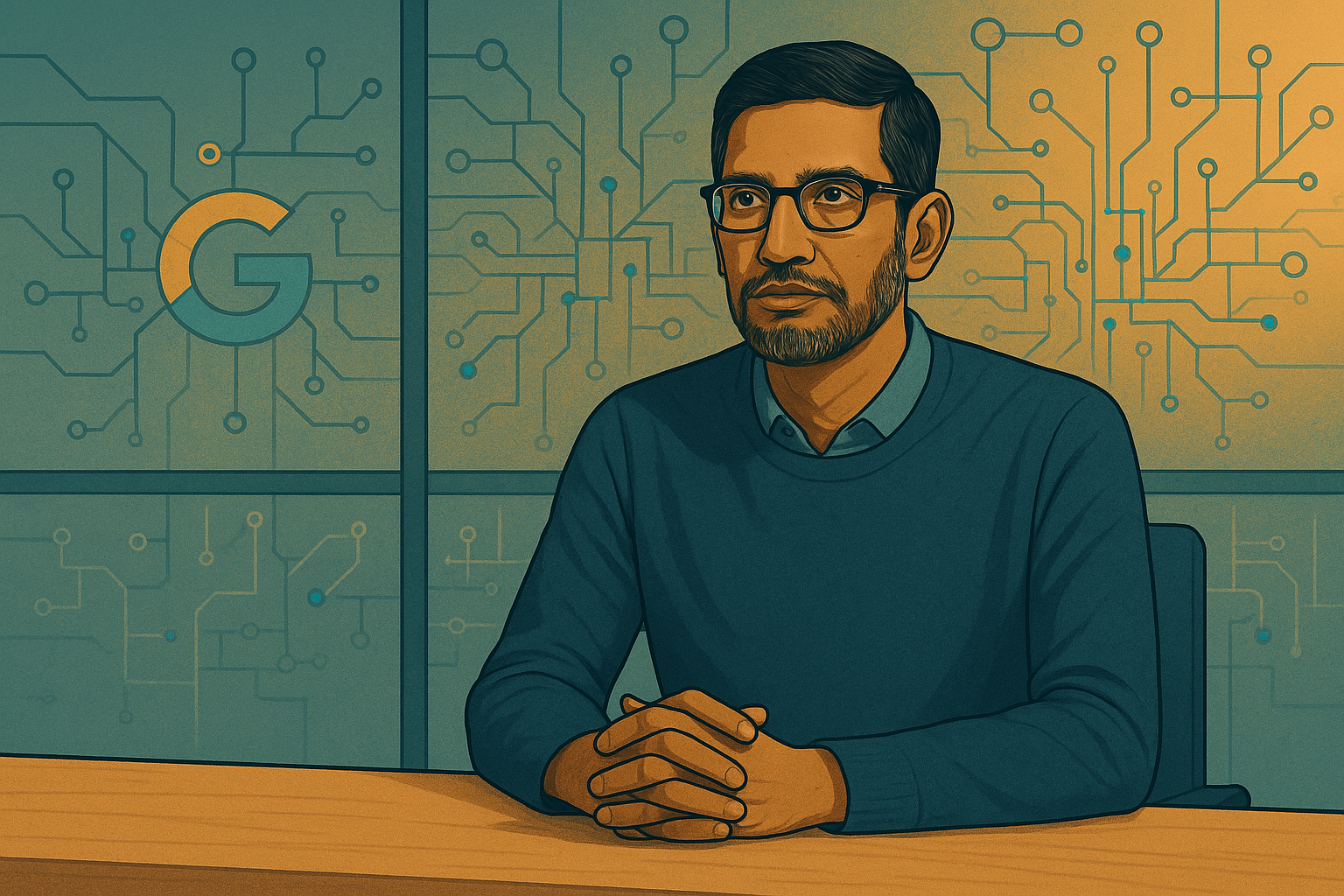
Alphabet chief executive Sundar Pichai has warned that no company would escape unscathed if today’s artificial intelligence boom turns into a full-blown market correction, underscoring how deeply AI valuations and infrastructure spending are now baked into global business.
Speaking to the BBC in an interview conducted at Google’s California headquarters, Pichai described the surge in AI investment as an “extraordinary moment” but said there were “elements of irrationality” in the market. The comments echo long-running comparisons with the late-1990s dotcom era, when investor exuberance outpaced sustainable business models.
Asked whether Google itself could ride out an AI crash, Pichai said the company would be able to weather the storm, but added: “I think no company is going to be immune, including us.” Alphabet’s shares have risen about 46% so far this year as investors bet on its ability to compete with OpenAI and other generative AI leaders.
The warning lands at a moment when central banks, regulators, and market commentators are increasingly focused on AI-linked concentration risk. Recent sell-offs in major technology names followed cautions from Wall Street leaders that equity markets may be due a correction, with several analysts questioning whether AI-driven earnings expectations are realistic at current valuations.
For the UK, the stakes are particularly high. Alphabet pledged £5 billion over two years in September for AI infrastructure and research in Britain, including a new data centre and further investment in DeepMind, its London-based AI lab. Pichai also confirmed Google would begin training AI models in the UK, aligning with Prime Minister Keir Starmer’s ambition for the country to become the world’s third AI “superpower” after the United States and China.
That ambition brings an energy and sustainability dilemma. Pichai told the BBC the energy needs of large-scale AI are “immense”, and said Alphabet’s net-zero emissions targets would be pushed back as the company increases computing capacity. For corporate leaders under pressure to decarbonise, the message is clear: AI-led growth is now inseparable from long-term climate planning.
Roman Stanek, founder and CEO of GoodData — which works with enterprises including Visa, Mastercard, and Zalando — argues that framing AI purely as a speculative bubble misses the structural shift underway in how organisations use data.
“People keep asking if AI is a bubble, and will this bubble pop? But AI isn’t a bubble; it’s a transformation,” he says. “Every technology bubble in history left behind real value – the internet, cloud, mobile. AI isn’t speculative, it’s compounding. You can’t uninvent intelligence. The companies waiting for the ‘bubble to pop’ will wake up to find the world has moved on without them.
“Building frontier LLMs costs hundreds of millions of dollars. This is similar to life sciences or chip design – you need massive capital, deep expertise, and a tolerance for failure. Only a handful of companies can play that game. But that doesn’t mean we’re dependent on big tech. Our role is to make AI usable and governed for enterprises – to bridge the gap between raw capability and real business outcomes.
“AI isn’t a feature, it’s the new operating model. Businesses and Governments who treat AI as a side project will miss the real transformation. All businesses need to be completely rethought. Not just the chatbots, storefronts and apps – but how data, enterprise systems, and decisions work together. We’re not adding AI to business processes; we’re rebuilding those processes around AI.”
For business leaders, the combined messages from Big Tech and enterprise providers point in the same direction: exposure to AI is now systemic, whether or not today’s valuations prove sustainable. The strategic challenge is less about avoiding a notional “AI bubble” and more about ensuring that capital, data governance, and operating models can withstand both rapid growth and a potential market reset.
We recently wrote about the AI boom and how it is showing parallels to the dot-com bubble on BQ Executive. Click here to read the article on the five lessons boards should take from when the dot-com bubble burst.