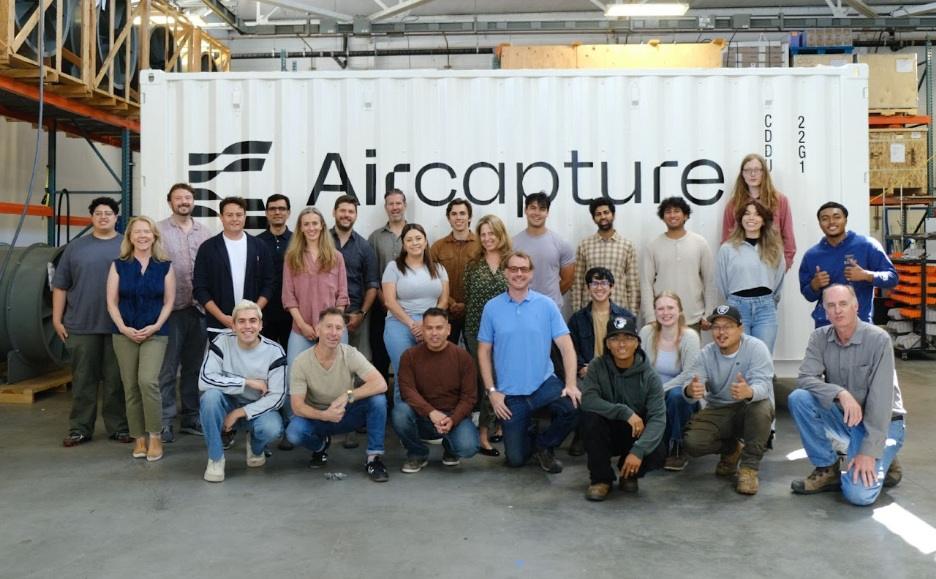
Carbon removal technology firm Aircapture has announced a $50 million Series A funding round, aimed at scaling its Direct Air Capture (DAC) systems to capture and recycle CO2 at industrial sites.
Founded in 2019, the California-based company provides modular on-site DAC machines that extract CO2 from the atmosphere, making it available for customers’ production processes. These modular units are designed to integrate directly into the production processes of industrial manufacturers, tailored to the specific requirements of each company.
Recently, the company, alongside its partner 44.01, received $1 million from the XPRIZE Carbon Removal competition for a DAC project in the UAE. Following this achievement, Aircapture has secured multi-year agreements with major global brands, including AB InBev.
Their solution eliminates the necessity for CO2 transport, thus reducing costs and emissions associated with transportation, and helps to eradicate impurities in products, aiding commercial clients in achieving carbon neutrality.
Matt Atwood, CEO and Founder of Aircapture, stated:
“Our model delivers high-purity atmospheric CO₂ directly at the point of use, creating immediate economic value and significantly reducing the footprint of traditional CO₂ supply chains. With this funding, we’re expanding our technology deployment, accelerating project financing and manufacturing, and continuing to reduce the cost of direct air capture—making large-scale carbon removal a global reality.”
The funding round was led by the Lam Larsen Climate Change Foundation. Aircapture plans to use the new funds to enhance manufacturing capacity for its next-generation containerised DAC units, expand its commercial deployments across North America, Europe, and Asia, and increase its engineering and deployment teams.
Chris Larsen, founder of the Larsen Lam Climate Change Foundation, commented:
“Climate action requires scalable solutions that align carbon dioxide removal with commercial viability. Aircapture’s technology stands out because it delivers tangible, scalable benefits today. Their approach provides essential CO₂ for industries that depend on it daily while reducing atmospheric carbon levels. We’re investing in a proven model that can scale rapidly across mature commercial markets, carbon utilisation and sequestration.”