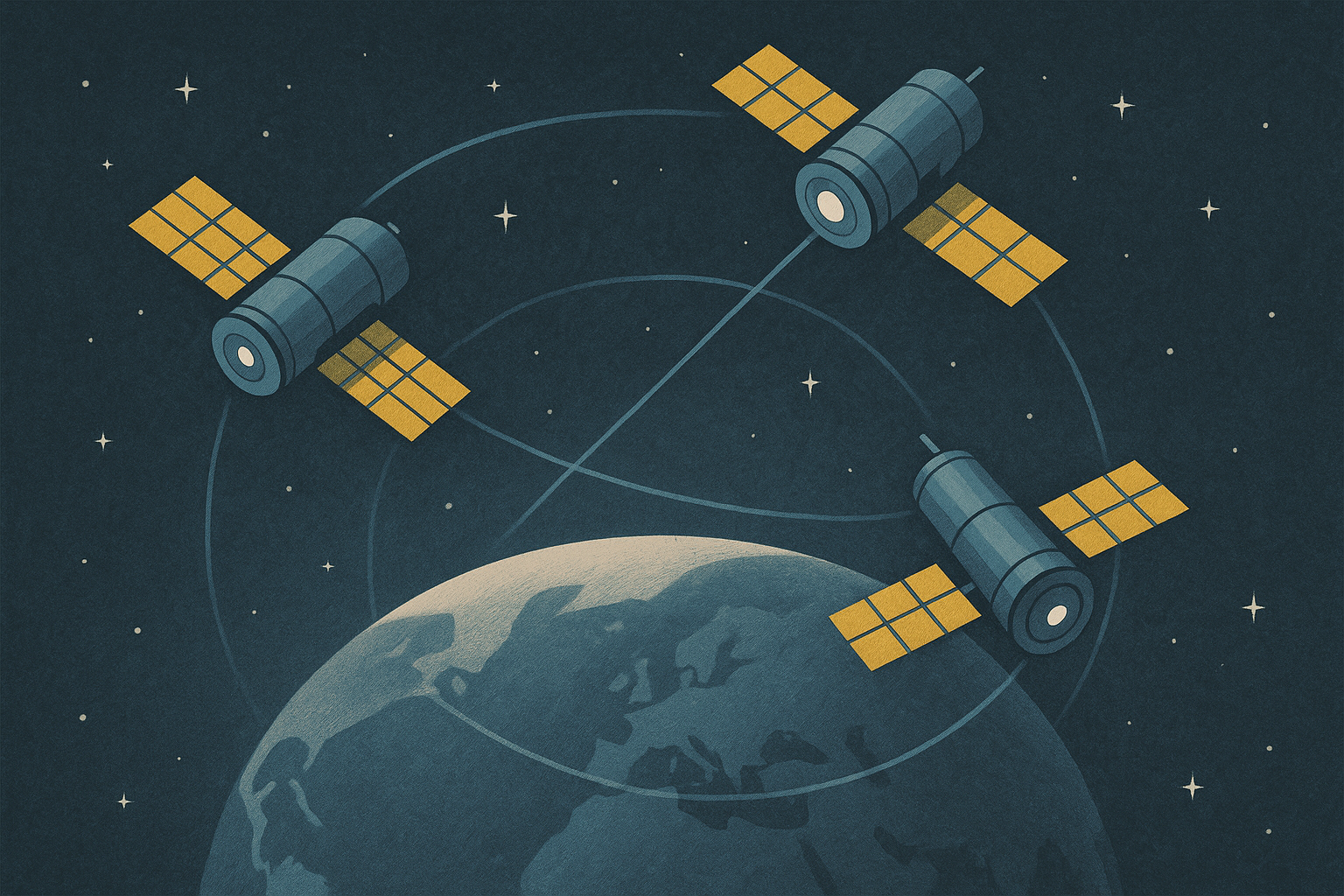
Airbus, Leonardo and Thales have agreed to combine their space operations under a single joint venture, forming what the companies describe as a leading European player in satellite and space systems. The alliance marks one of the most significant industrial consolidations in the continent’s aerospace and defence sector in recent years.
The three groups signed a Memorandum of Understanding on 23 October to merge their activities in space infrastructure and services — excluding launchers — into a new organisation. The company, jointly owned by Airbus (35%), Leonardo (32.5%) and Thales (32.5%), is expected to be operational by 2027, subject to regulatory clearance and employee consultation.
Based across multiple European sites, the combined entity will employ around 25,000 people, with an annual turnover of roughly €6.5 billion and an order backlog exceeding three years of projected sales. It will integrate Airbus’s Space Systems and Space Digital units, Leonardo’s Space Division and stakes in Telespazio and Thales Alenia Space, and Thales’s holdings in Thales Alenia Space, Telespazio and Thales SESO.
The companies said the venture is designed to strengthen Europe’s strategic autonomy in space and increase competitiveness in a global market dominated by the United States and China. By uniting their research, technology and production capabilities, the partners aim to accelerate innovation, create economies of scale, and deliver new programmes in communications, navigation, Earth observation and national security.
Guillaume Faury, Chief Executive Officer of Airbus, Roberto Cingolani, Chief Executive Officer and General Manager of Leonardo, and Patrice Caine, Chairman and Chief Executive Officer of Thales, said the partnership represented a pivotal step for Europe’s industrial and technological strength. “This proposed new company marks a milestone for Europe’s space industry,” the leaders said. “By pooling our talent, resources and R&D capabilities, we aim to generate growth, accelerate innovation and deliver greater value to our customers and stakeholders.”
The partners expect the combination to yield mid triple-digit million-euro annual synergies on operating income within five years of closing, with integration costs aligned to industry benchmarks. They added that the consolidation would bring stability to Europe’s space ecosystem and create new opportunities for suppliers and employees alike.
If approved, the new company will serve as a trusted partner for European sovereign programmes and act as a cornerstone of the continent’s long-term strategy for technological independence in orbit.