
Succession is most delicate when the business is healthy enough to avoid panic, but unsettled enough that continuity alone does not feel like an answer.
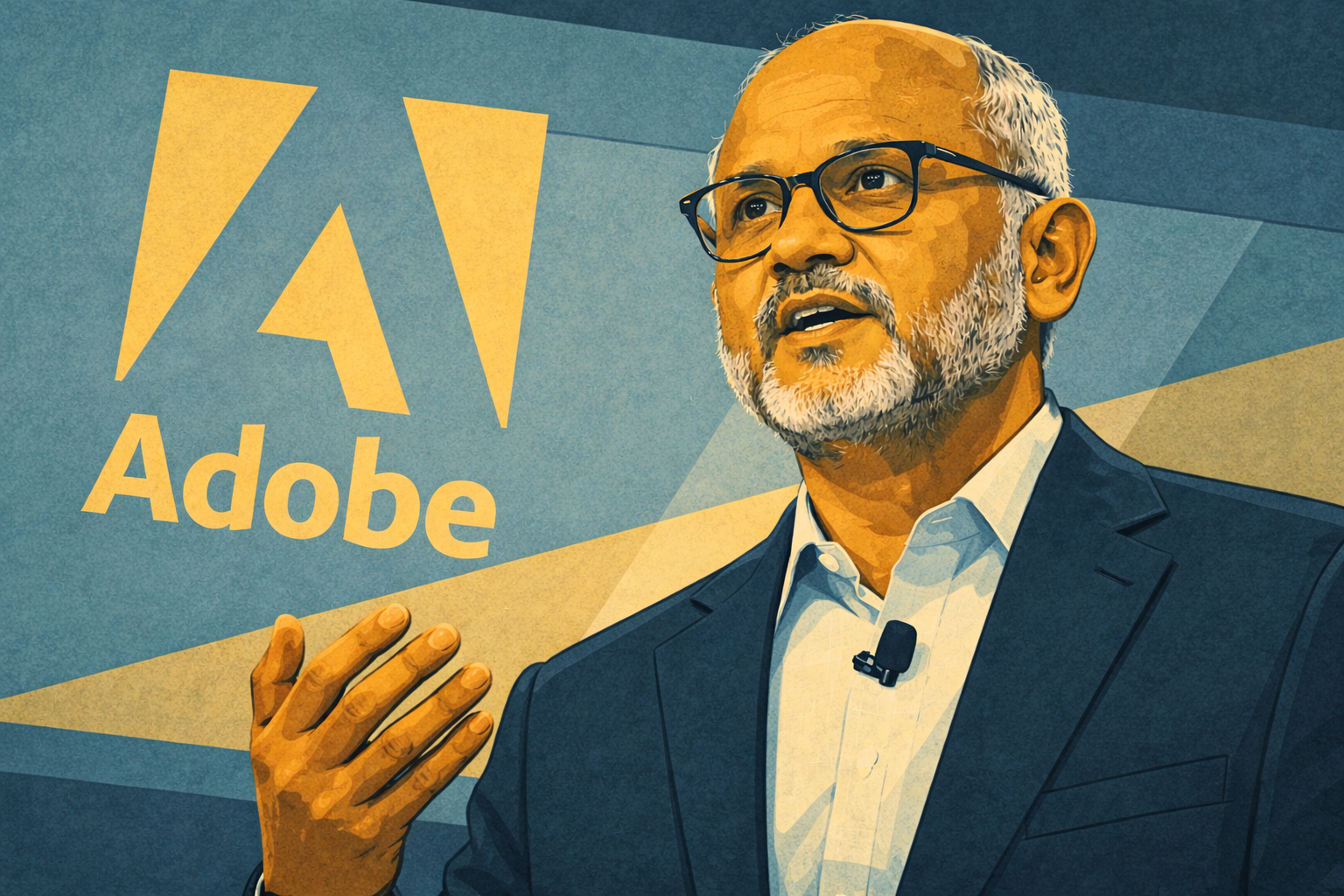
Adobe now finds itself in exactly that position. Shantanu Narayen has said he will transition from the chief executive role after a successor is appointed, while remaining chair. The board has initiated a search that will consider internal and external candidates.
On its face, this is an orderly handover. In reality, it arrives at a moment when the company is being asked to defend not only its growth, but the future shape of its moat as AI lowers barriers, changes workflow expectations, and intensifies scrutiny of how creative software will be monetised in the next phase.
Narayen has framed the transition as part of setting Adobe up for its next decade of growth. In the same set of announcements, he argued that the company’s mission to “empower everyone to create” represents an even larger opportunity in the AI era.
Adobe is already trying to prove that it can translate AI adoption into both usage and revenue across a wide product estate. In its first-quarter fiscal 2026 materials, the company said revenue reached $6.40 billion, non-GAAP earnings per share came in at $6.06, and annual recurring revenue from AI-first applications more than tripled year over year. It also said it had surpassed 850 million monthly active users across Acrobat, Creative Cloud, Express, and Firefly.
Yet strong numbers did not remove the unease. Adobe’s shares fell more than 7% in extended trading after the announcement of Narayen’s departure. The market reaction suggested that investors were not judging performance in isolation. They were reacting to a leadership transition landing in the middle of a broader software repricing, where AI is reshaping expectations around product economics, speed of innovation, and the durability of incumbent business models.
Adobe remains profitable, influential, and deeply embedded in creative and enterprise workflows. Even so, the company is being measured against a more demanding question than simple earnings quality: can a long-dominant platform still lead when generative tools reduce the friction of creation and compress the distance between established vendors and newer challengers?
That is what makes the succession issue more strategic than symbolic. In a settled market, the board might optimise for continuity, operational discipline, and careful execution. In the present environment, continuity may be necessary, but it is unlikely to be sufficient. Adobe’s next chief executive will inherit a company that must keep defending premium categories while broadening AI-enabled products, managing monetisation across multiple routes to market, and deciding how aggressively to move on partnerships, acquisitions, and new pricing structures. The board is therefore not choosing only a leader. It is choosing a tempo. How much reinvention should the next chapter absorb, and how quickly?
There is also a subtler governance question in the structure of the transition itself. Narayen will stay on as chair, much as he noted his own predecessors supported him when he took the role. That arrangement can be stabilising, especially when a company is managing a high-stakes handover under public scrutiny, but it can also cast a long shadow. Long-tenured leaders leave behind strong institutions and coherent operating systems, but they can also leave assumptions that are harder for successors to challenge, particularly when the strategic environment is changing quickly. The board’s test is not simply to preserve Adobe’s strengths. It is to ensure the incoming leader has enough room to reinterpret them.
Adobe’s handover is therefore less about inheritance than calibration. The company is not passing from one era of stability to another. It is moving through a profitable, but unsettled, transition in which AI is both an opportunity engine and a source of investor doubt. That makes the familiar phrase “safe pair of hands” less useful than it once was. The safer choice may no longer be the least disruptive one. Adobe can navigate that tension well but it will do so only if the board treats succession as a live strategy decision.


You must be logged in to post a comment.