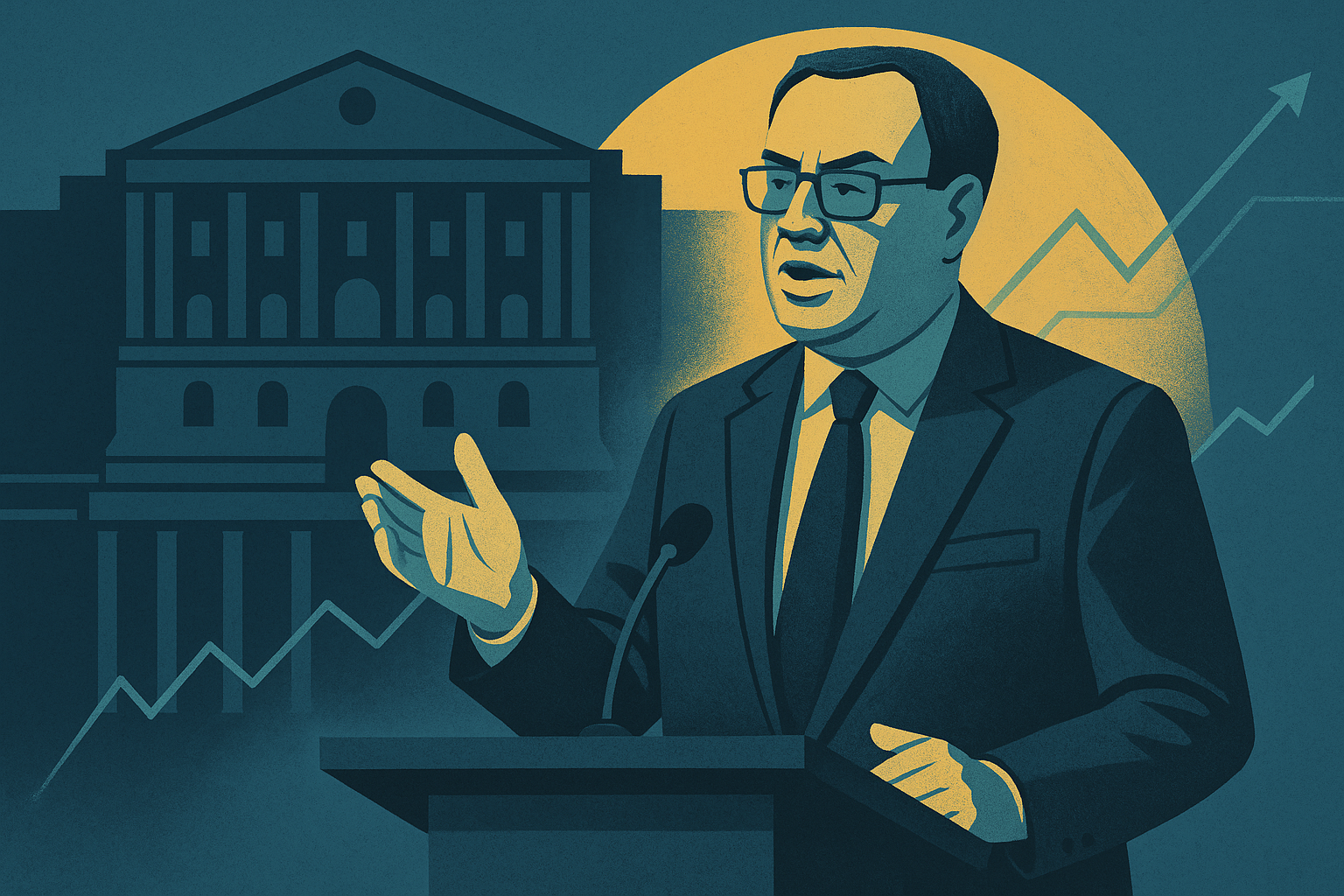
The Bank of England is holding back on further interest rate cuts due to escalating global tariff uncertainty, Governor Andrew Bailey has warned.
Speaking at the European Central Bank’s forum in Sintra on 1 July, Bailey said businesses were “holding back investment” while they assessed the impact of recently announced U.S. and other global tariffs. That hesitation, he said, was a key reason the Monetary Policy Committee (MPC) left Bank Rate at 4.25 per cent in June.
“Keeping policy tighter while firms are already paralysed by tariff risk might only exacerbate the slowdown,” Bailey told The Independent on 2 July, explaining that the MPC chose to proceed gradually until it could review clearer data.
The caution follows a five-to-four MPC vote in May to cut the Bank Rate by 25 basis points — a decision shaped largely by the expected drag on UK growth from U.S. President Donald Trump’s sweeping tariff package announced in April. Bailey’s subsequent press conference and June testimony to Parliament framed the Bank’s position as “gradual and careful” — a phrase now anchoring its forward guidance.
Markets still price in a 75 to 80 per cent chance of a quarter-point rate cut at the MPC’s next meeting on 1 August, but back-to-back reductions now appear unlikely. Traders cite the same tariff-driven uncertainty highlighted by the Bank.
The effects of the tariffs are being felt on multiple fronts. In its May forecasts, the Bank estimated that higher U.S. import duties would reduce UK GDP by 0.3 percentage points over three years and lower CPI inflation by 0.2 points by year two. Beyond the headline impact, Bailey emphasised the indirect effects — calling the current trade environment a “pricing and supply-chain fog” that is suppressing capital expenditure across sectors.
Inflation remains a mixed picture. While tariffs can lift import costs initially, they may later drive disinflation if global demand slows. “It is too soon to see the price effects,” Bailey told The Independent, adding that the Bank would not pre-judge the eventual outcome.
The economic implications are already taking shape. A Reuters poll shows economists now expect only two rate cuts this year, compared with three a month ago. Survey data reveals a dip in corporate orders, particularly among manufacturers and housebuilders, where investment in plant upgrades and imported materials is stalling.
Financial institutions remain divided. JP Morgan Private Bank noted that May’s narrow MPC vote “sent a more hawkish message,” while ING pointed out that sterling’s 3 per cent appreciation this year — partly due to tariff expectations — could make imported goods cheaper, reinforcing the BoE’s cautious stance.
Trade-exposed firms are also sounding alarms. UK packaging group Mpac issued a profit warning last week, citing U.S. tariffs, while major construction firms flagged new cost pressures in their supply chains.
The next key milestone will come on 9 July, when the U.S. is set to finalise a list of bilateral exemptions. If UK sectors fail to secure carve-outs, the Bank may be forced to manage a stagflationary scenario — balancing slower growth with stubborn import-driven inflation.