
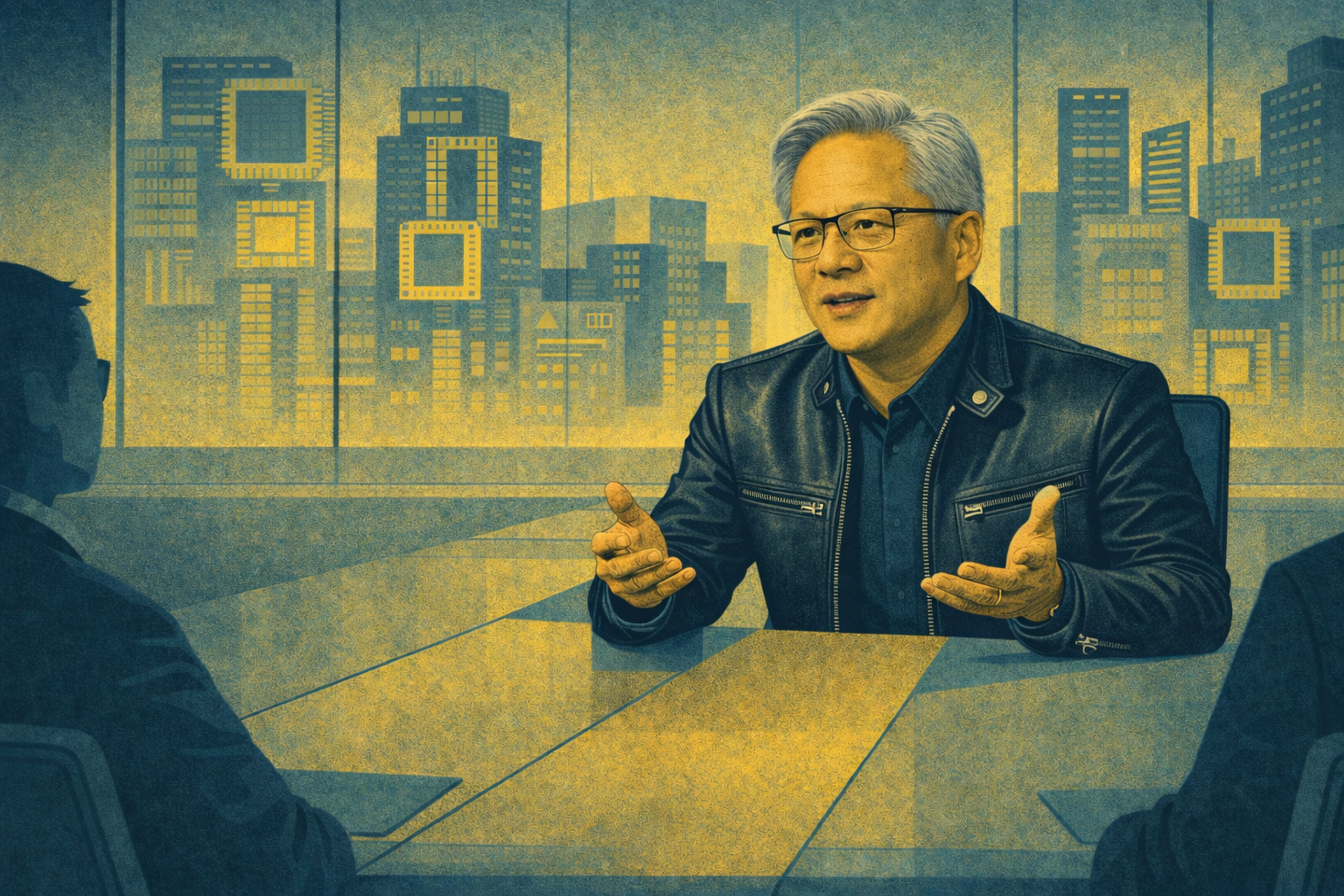
Nvidia chief executive Jensen Huang has signalled that the company’s era of headline-scale equity cheques into the leading AI model developers may be drawing to a close. Speaking at Morgan Stanley’s Technology, Media and Telecom conference on Wednesday, Huang said Nvidia’s latest investments in OpenAI and Anthropic “might be the chipmaker’s last” in both companies as they prepare to go public this year.
Huang said, “The opportunity to invest $100 billion in OpenAI is probably not in the cards” because the ChatGPT developer is “set to go public later this year”. Nvidia and OpenAI had announced a $100 billion deal in September last year, a tie-up that would have deepened a relationship already defined by OpenAI’s demand for Nvidia’s data centre hardware.
Nvidia has instead finalised a $30 billion investment in OpenAI. Huang said the move “might be the last time it has the opportunity to ‘invest in a consequential company like this,’”. OpenAI did not immediately respond to Reuters’ request for comment.
The comment lands amid a fresh reshaping of OpenAI’s capital base. Last week, OpenAI announced a $110 billion funding round led by Amazon, with SoftBank and Nvidia each contributing $30 billion. The size of the raise underlines how quickly frontier-model development has become an infrastructure question as much as a software one, with investment rounds now framed in data centre capacity, power, and long-term compute supply.
For Nvidia, the proximity of an IPO appears to be part of the logic for stepping back from further private cheques. Reuters previously reported OpenAI is laying the groundwork for an initial public offering that could value the company at up to $1 trillion, and is considering filing as soon as the second half of 2026, though plans could change.
The structure of Nvidia’s OpenAI relationship has also drawn scrutiny. Reuters noted that some analysts raised concerns about “the circular arrangement” implied by the earlier proposal, with Nvidia investing heavily in one of its biggest customers and the capital likely flowing back into purchases of Nvidia’s own AI processors. Reuters also reported that the Financial Times said Nvidia and OpenAI had abandoned the $100 billion deal amid doubts about the health of the AI sector.
Huang has argued that Nvidia’s priority is supplying the computing capacity that frontier-model developers require. “The revenues will more than follow,” he said, referring to demand for Nvidia systems as those developers scale training and deployment.
Huang also said Nvidia’s $10 billion investment in Anthropic “probably will be the last as well,” as the Claude developer considers an IPO. Anthropic did not immediately respond to Reuters’ request for comment.
The Anthropic timing is complicated by politics as well as markets. Reuters reported this week that investors and large backers are pushing to de-escalate a dispute with the Pentagon over safeguards, after the U.S. Defense Department considered labelling Anthropic a “supply-chain risk” amid disagreements around battlefield use and surveillance constraints.
Nvidia’s investment activity sits within a wider set of capital and infrastructure alliances across the sector. Reuters has catalogued a wave of multi-billion-dollar deals that bind chip suppliers, cloud providers, and model developers together as the industry competes for compute — and for the financing needed to secure it.



You must be logged in to post a comment.