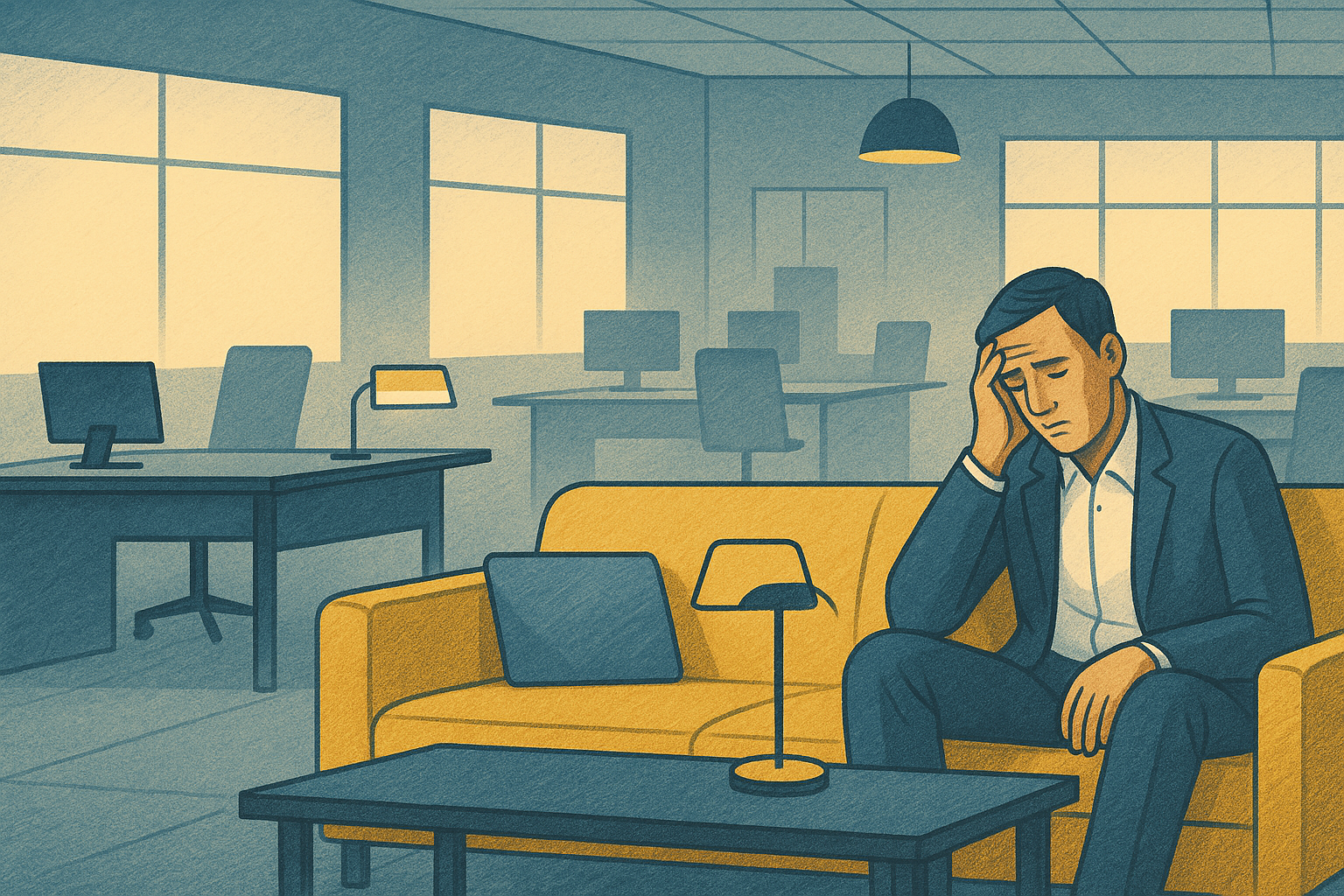
Millennials are no longer the youngest generation in the workforce. Many are now in their thirties and early forties, occupying supervisory and middle management roles across organisations. Yet for a growing number, the sense of forward motion that once defined their careers has slowed — or stopped altogether.
The conversation around burnout has often focused on early-career exhaustion. But recent data suggests a more complex pattern. Mental Health UK’s 2025 Burnout Report shows increased stress-related absences among 25–34-year-olds, alongside a continuing upward trend in burnout among 35–44-year-olds — the very cohorts now moving through early and mid-management. The issue is not confined to entry-level strain; it extends into the organisational middle.
Part of that tension reflects an expectations gap shaped by timing. Many Millennials entered the workforce during the final years of economic expansion in the late 1990s and early 2000s. The internet economy was accelerating, professional roles were expanding, and upward mobility appeared embedded in corporate culture. That trajectory was interrupted by successive shocks — the dot-com collapse, the global financial crisis, prolonged wage stagnation, and the pandemic.
Even for later Millennials that entered the working world in the wake of the 2008 financial crisis and may have experienced the upsides of gradual economic recovery, the pandemic disrupted that.
Research from the Resolution Foundation, published in late 2023, underscores the shift. Younger Millennials earned around 8% less at age 30 than Generation X did at the same age, reflecting weaker income progression than previous cohorts experienced. While senior leaders today may recall steady early-career advancement, the data shows a flatter path for those who followed.
Jo-Ellen Grzyb, psychotherapist and co-founder of professional skills training company Impact Factory, argues that the resulting disillusionment is less about entitlement and more about preparedness. “It wasn’t so much that Millennials were ‘promised’ stable careers and long-term security: it’s that they weren’t taught that the world of work can be volatile and that they needed to learn the skills to spot that volatility when it’s in their vicinity, nor how to be flexible enough to make the kinds of changes needed to feel in charge.”
In practice, that volatility has reshaped organisational design, with hierarchies flattening, promotion cycles slowing, and digital transformation and automation fundamentally altering role structures. For many in mid-career, the next step has become less clearly defined.
“It’s as though a mid-life crisis was thrust upon them from external circumstances,” continued Grzyb. “Mid-life crises tend to be triggered internally, with people questioning their lives, their relationships, their purpose; for many Millennials it was the reverse.”
Financial pressure compounds that reassessment. Deloitte’s 2025 Gen Z and Millennial Survey found that nearly half of Millennials do not feel financially secure, despite placing strong emphasis on career progression, purpose, and work-life balance. As responsibilities — be they mortgages and families or leadership accountability — increase, perceived instability carries greater weight.
The risk lies in employers misreading the signal. Disengagement may be interpreted as fragility, or stalled ambition may be framed as unrealistic expectation. Yet the stress data suggests something more structural. Mental Health UK reports that burnout among 35–44-year-olds continues to rise — a cohort central to operational delivery and succession planning.
Grzyb maintains that rebuilding agency remains possible, but it requires adaptation. “From my perspective, getting back to feeling more in charge and facing the realities of today’s world of work, has to start with building resilience and being more adaptable, and no one can say that making those kinds of pivots is easy.”
Resilience, however, does not sit solely with individuals. Transparent progression pathways, lateral development opportunities, and honest communication about advancement prospects are organisational responsibilities. If the middle layer feels stalled, succession pipelines narrow and retention risk increases.
Millennials now sit at a pivotal point in the workforce — experienced enough to lead, yet still early enough in their tenure to shape the next two decades of corporate life. Whether that potential translates into renewed engagement or quiet withdrawal may depend less on generational mindset, and more on how organisations respond to a career path that has proved less predictable than many once assumed.