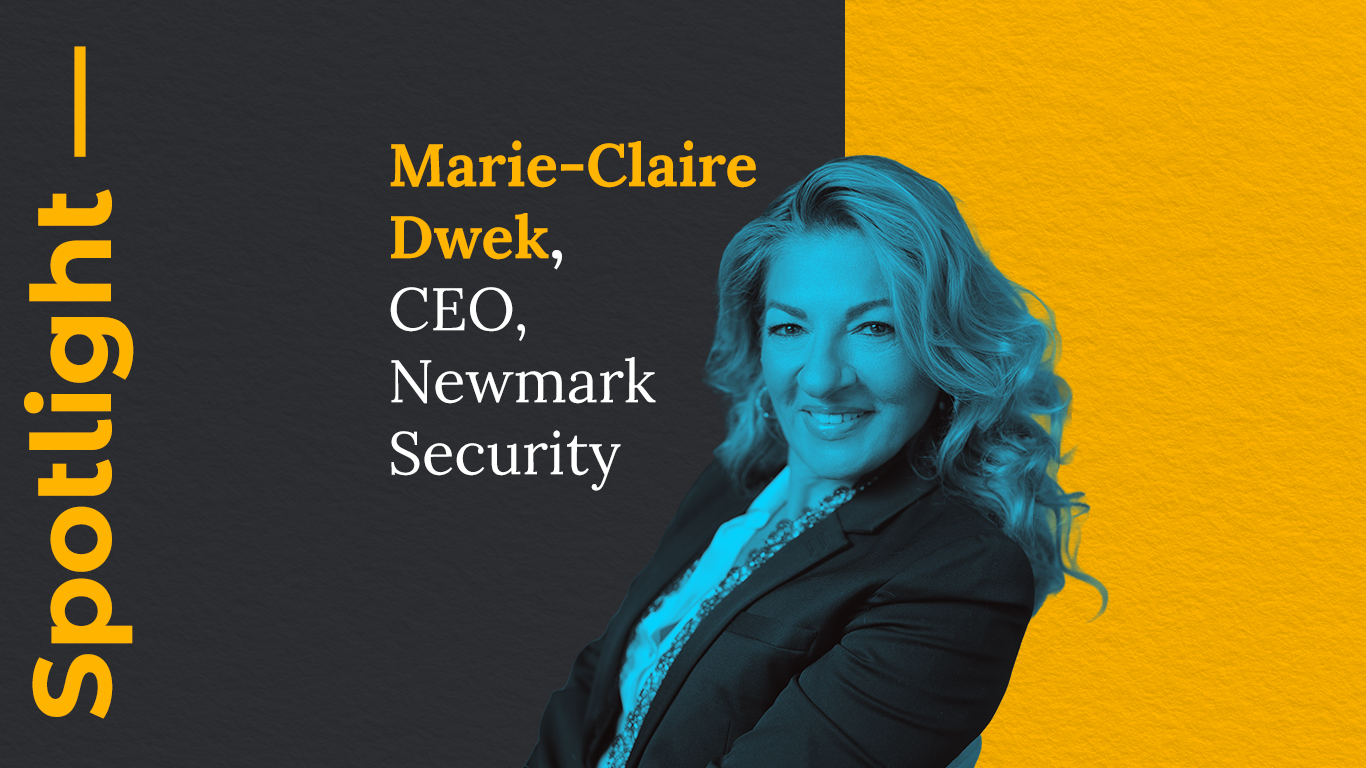
When Marie-Claire Dwek talks about resilience, she is not speaking in abstractions. As chief executive of Newmark Security, the AIM-listed technology company that helps protect people and data in workplaces around the world, her career has been defined by coming back from loss — twice — and turning adversity into momentum.
Newmark today employs 120 people across London and Miami, generating turnover of £23 million. Its specialist hardware and software help organisations manage physical access, time, and identity data, with clients ranging from Walmart, Tesco, and Marks & Spencer to the Met Police and BAE Systems, supported by partners including Oracle, SAP, and Workday. It is not a cybersecurity or infosec play, but a physical and human capital management business rooted in how people actually enter and move through workspaces.
That vantage point belies how close Dwek has come to having nothing. “This will never happen to me again,” she once vowed. She now credits her success to “strength through adversity” — a theme woven through her family history and professional journey.
Refugee roots and entrepreneurial heritage —
Dwek grew up in a household where the shock of displacement was still fresh. Her mother’s family left Sudan when it became too dangerous to return home from boarding school in England. Her father’s family, Egyptian citizens with British passports, were caught in the aftermath of the Suez Crisis. In 1959, all British passport holders were expelled, their assets confiscated, their home taken without compensation. They arrived in the UK with one suitcase each and just one pound in cash, spending their first months in internment camps in the north of England.
Out of that experience, her father, Maurice Dwek, built a life in business. Invited to the Royal Military Academy Sandhurst as a teenager, he could not afford the uniform. Instead, he started selling uniforms and clothing across Europe, becoming a serial entrepreneur and, as his daughter recalls, one of the youngest people to float a public company at 23.
“My father was one of the youngest people to float a public company at age 23, so I grew up in the shadow of a man who met success from an early age. As a girl growing up in London, my siblings and I were chauffeur-driven to school, which was a major departure from my parents’ struggle as young immigrants in a new country just a few years earlier.”
The household soundtrack was dealmaking rather than small talk. “Unlike the typical conversations between fathers and daughters, my father would often tell me business stories. I recall spending my holidays at his plastics factory in Greenwich (Dwek Group) and I’d sit in the fascination of telex room or work in the warehouse – it was an exciting albeit untypical environment for a young girl.”
She traces his drive directly to the experience of leaving everything behind. “My father’s early business success was certainly down to the ‘immigrant mentality’. I grew up in an environment where many families from various countries came to Britain under similar challenging circumstances – all worked exceptionally hard, and reaped the rewards.”
Finding the right footing —

Dwek initially took a more creative path. After studying history of art, she completed an interior design course at the Inchbald School of Design, and began doing up flats around London. Engaged at 18, married at 19, and a mother by 22, she mixed property projects with work in Trulo, her father’s swimwear business, which held licences with brands and personalities such as Jerry Hall, Valentino, and Michael Kors.
The early 1990s property crash brought that world to an abrupt halt. “We were given 24 hours to vacate the property before repossession. I was a young mother with children aged four and two, with no backup plan.” Over-leveraged on their family home, she and her husband lost it.
Searching for a new foothold, the pair took a controlling stake in a small engineering business spun out of a conglomerate in receivership. The company was called Newmark. “I needed to take control of the situation, and I did so by going to study marketing at night to expand my skills. As a result, I handled all the marketing for the early days of us taking over Newmark.”
The timing was unforgiving. As the business found its feet, her marriage broke down. She left the family home and moved into a small studio. “Having to work daily with my ex on our new business, and having to visit my children every day, and not go home to them was an incredibly dark chapter in my life.” Eventually, she stepped away from Newmark altogether, determined to rebuild on her own steam.
A decade with the Reuben brothers —
That decision led her into the orbit of property magnates Simon and David Reuben. She joined their vehicle, Motcomb Estates, with no formal title and no fixed role, initially struggling to work out where she could add value.
She began in commercial and residential lettings, then moved into refurbishment projects, before progressing into the sales and acquisitions that would become the engine of the Reubens’ multi-billion-pound portfolio. These were not small deals: the group’s assets have included London landmarks such as Millbank Tower, the In & Out Club, and Admiralty Arch.
“It’s an understatement to say that Simon Reuben, with whom I would eventually work closely, is a formidable business negotiator, and it’s this environment where I continued to learn.” Over more than a decade, she helped lead some of the UK’s highest-profile commercial real estate transactions, sharpening her instincts around risk, capital, and timing.

Newmark round two —
By 2013, Dwek was ready for a fresh challenge. Circumstances at Newmark had also shifted. Her ex-husband had long since exited, and the board was searching for a new chief executive. Dwek, who had maintained strong relationships with directors, was invited back to lead the company she had once helped to acquire, and later felt forced to abandon.
She returned to find a business that was still largely an engineering operation. Newmark was known for its access control products — secure devices that govern how people enter workplaces — and for its human capital management “clocks”, the time and attendance hardware that enables millions of staff to clock in and out each day. But the company offered little in the way of services, leaving long-term value on the table.
Under Dwek’s leadership, Newmark has repositioned around a service-led model. The group’s Safetell subsidiary delivers physical security installations, from asset protection solutions to counter-terror deployments. Grosvenor Technology supplies the hardware and software that secure identity and time-keeping data while helping customers maintain privacy, reduce cost, and stay compliant.
One of her most significant strategic moves has been to build recurring revenue streams. Newmark now takes on the headache of managing hardware, compliance, and data protection, shifting much of the complexity into the cloud. The service side of the business is its fastest-growing segment, particularly in the United States. Reputation has been a critical growth driver — the company says it has never lost a customer.
In essence, Newmark helps organisations protect human capital in safe spaces, giving them secure, cloud-based control over who is on site, when, and with what permissions.
Strength through adversity —
Dwek has navigated two male-dominated industries — commercial property and security technology — while carrying formative memories of loss that could easily have pushed her to play it safe. Instead, they hardened her resolve.
“Life is short, life is valuable. I’ve learnt never to let any day go by, being mundane. My mantra is to always do one meaningful thing in day – a gift to myself – even if it’s as simple as a 10-minute walk in the park. I believe in living life to the fullest.”
Her focus now is on expanding Newmark’s recurring revenue base, deepening its presence in the US, and using acquisition to accelerate growth. The business is designed for stability and sustainability, but the fuel behind it is personal: a promise made years ago in the wake of a property crash and a repossession notice, that she would never again be so exposed.
For Dwek, resilience is not an abstract leadership quality or a buzzword liberally applied. It is a discipline, forged through experience, that has turned a once-struggling engineering firm into a growing, people-centric security technology company.