Concerns around global fuel supply and wider geopolitical instability continue to cause uncertainty. However, while much of the spotlight on this is the effect upon consumers, the implication for business is also significant.
As such, recent disruption has encouraged many organisations to reassess supply chains and energy security, diversify suppliers and improve contingency planning. Yet business travel is often treated differently. Travel decisions are frequently shaped by familiar booking habits and established ways of working rather than a conscious assessment of resilience.
This is significant as business travel remains essential for building relationships, supporting collaboration and pursuing growth opportunities. As businesses look for greater certainty in an increasingly unpredictable environment, there is an opportunity to rethink whether the travel choices employees make are contributing to a resilient business strategy.
How familiar choices become a business risk —
The biggest risk in business travel is often behavioural rather than operational. In most organisations, booking behaviour develops through habit and familiarity, with people naturally gravitating towards the routes, platforms and modes of transport they know best. Our research found that two-fifths (40%) of business travellers default to booking options they are already familiar with, even when these may not be the most efficient choice.
Many organisations have access to alternative routes and modes of transport, but these are not always embedded into everyday decision making. Rail provides a useful example. Despite extensive connections linking major business hubs across the UK and Europe, rail is often treated as an alternative when disruption occurs, rather than a strategic option considered from the outset.
Resilience should not be built during a crisis, but rather, developed through the choices organisations make day-to-day.
Rail: certainty in uncertain conditions —
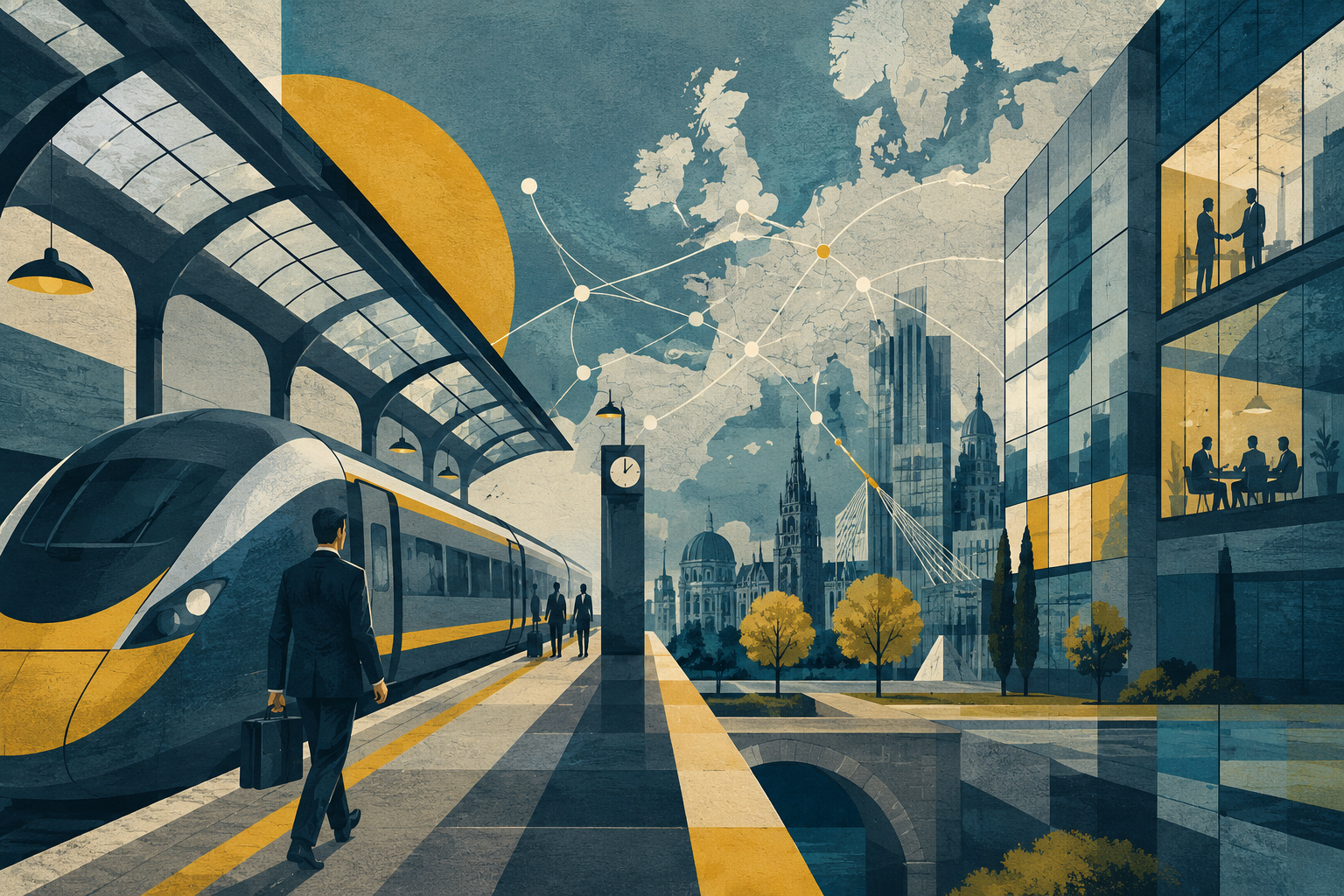
When businesses broaden the travel options employees routinely consider, they are better positioned to adapt when external conditions become less predictable. One reason many organisations overlook rail when considering travel resilience is that it is often associated primarily with domestic journeys and perhaps the occasional short-haul trip from London to Paris. In reality, Europe’s rail network offers a diverse range of fast and reliable connections between major business hubs, linking cities such as Brussels, Amsterdam and Paris through established cross-border routes.
This is where rail can offer businesses greater certainty. While concerns around global fuel supply and wider geopolitical instability continue to raise questions about the resilience of air travel, rail offers a dependable alternative through consistent timetables, city-centre-to-city-centre journeys and greater visibility over travel costs.
It also supports productivity. City-centre arrivals reduce the time lost travelling to and from airports, while onboard space gives employees the opportunity to work, prepare for meetings and stay connected while travelling. For businesses trying to maintain momentum during uncertain periods, that reliability and usable time matters.
Importantly, rail’s value is greatest when it forms part of everyday travel planning. Not to mention, 64% of business travellers are more inclined to book rail where possible, and tickets booked through Trainline Business are, on average, 58% cheaper when purchased at least one week in advance. Thus, to make use of this, integrating rail is less about changing employee preferences and instead about ensuring rail options are visible, accessible and integrated into business travel planning.
Resilience and sustainability go hand in hand —
Rail is not only resilient; it is also good for the planet. As businesses face growing pressure to reduce emissions, travel choices are becoming an increasingly important part of wider sustainability strategies. Making rail the natural option for suitable business journeys helps organisations build greener habits while also reducing exposure to external shocks.
This is why resilience and sustainability should not be viewed as separate priorities. The same decisions that help businesses travel with greater certainty can also help reduce environmental impact. By embedding rail into everyday travel planning, organisations can strengthen their ability to respond to uncertainty while making more responsible choices about how their people move around.
Building resilience before disruption arrives —
While businesses cannot control external events, they can control how prepared they are to respond to them.
Business travel is no exception. By making rail a more natural part of everyday travel planning, businesses can reduce their exposure to disruption while supporting their sustainability ambitions. In an increasingly uncertain world, rail should be viewed not as a fallback option, but as a strategic part of a resilient business plan.

Sophie Fleming is Global Head of Trainline Business.