When the world shifted to remote working almost overnight in 2020, few predicted how profoundly it would reshape the modern workplace.
For many organisations, COVID-19 proved that employees could remain productive while working from home. As restrictions eased and hybrid working became the norm rather than the exception, business leaders began asking an obvious question: Do we still need the same amount of office space?
For decades, office planning was relatively straightforward. If you employed 200 people, you planned for 200 desks. Every employee had a permanent workspace, and offices were designed around occupancy rather than utilisation.
Hybrid working changed that completely.
If only half of your workforce is in the office on any given day, maintaining a desk for every employee no longer makes financial sense. For many organisations, reducing their real estate footprint became one of the quickest ways to reduce operational costs while adapting to new ways of working.
Across Europe, businesses continue to rethink how much office space they need. But reducing real estate has also forced organisations to think differently about how that space is managed. It’s no longer about providing enough desks for everyone; it’s about ensuring the right people have access to the right spaces at the right time.
Reducing office space wasn’t the end of the story. It was the beginning of a new challenge.
Less space doesn’t mean less demand —
One of the biggest misconceptions about hybrid working is that office attendance is evenly spread across the week.
It isn’t.
Many businesses experience what has become known as the “Tuesday to Thursday effect”. Mondays and Fridays can be relatively quiet, while the middle of the week sees offices buzzing with collaboration, customer meetings and team catch-ups.
Imagine a business with 200 employees that has reduced its workplace to 120 desks because, on average, only 100 people attend each day.
On paper, it works. Until 150 employees decide to come into the office on Wednesday.
Without visibility, employees arrive unsure whether they’ll find a desk. Teams become separated across different floors. Meeting rooms are fully booked while other spaces remain underutilised.
The issue isn’t that businesses reduced their office space, it’s that many reduced it without having the technology to manage it effectively.
The workplace has become dynamic —
Today’s office is no longer somewhere employees simply turn up to every day.
People come in to collaborate, meet customers, spend time with colleagues, and access facilities they don’t have at home. That means the workplace experience begins before someone even leaves the house.
Can I see whether my team will be in the office?
Can I reserve a desk nearby?
Is there a meeting room available?
Can I book everything I need before I travel?
These are simple questions, but answering them removes uncertainty and gives employees confidence that their journey into the office will be worthwhile.
For facilities and workplace teams, the benefits go much further. Instead of relying on assumptions, organisations can understand how their buildings are actually being used.
Which days are busiest?
Which floors remain underutilised?
Are collaboration spaces being used more than individual desks?
Is the current office layout still fit for purpose?
The conversation has shifted from managing buildings to managing workplace experiences.
The visitor experience matters just as much —
Employees aren’t the only people using today’s workplaces.
Customers, suppliers, contractors and prospective employees all form an opinion long before the meeting begins. Yet many visitor experiences still feel surprisingly outdated. Visitors arrive at reception and wait while someone tries to contact their host. Paper sign-in books still exist. Temporary badges are handwritten. Guests are left trying to navigate unfamiliar buildings, unsure where to go. A frictionless workplace removes these unnecessary moments.
Visitors can be pre-registered before they arrive, receive joining instructions automatically, check in digitally, notify their host instantly, and be guided to the correct meeting room through digital wayfinding.
The result is a better first impression, improved security and a smoother experience for everyone involved.
Technology shouldn’t exist in isolation —
One of the biggest mistakes organisations make is treating workplace technology as a series of individual purchases.
They invest in a desk and meeting room booking platform to support hybrid working. Later, they introduce visitor management, often alongside door access to improve security and reception. Digital signage and wayfinding are added as the workplace evolves, while meeting room technology is upgraded separately as collaboration requirements change.
Each solution may work perfectly well on its own, but the problem is that employees and visitors don’t experience them individually. They experience one workplace.
That’s why organisations need to think about the entire journey rather than individual products.
The question shouldn’t be:
“Which visitor management system should we buy?”
It should be:
“Where are people experiencing friction in our workplace, and how can we remove it?”
Technology comes afterwards.
The meeting room is where the experience succeeds or fails —
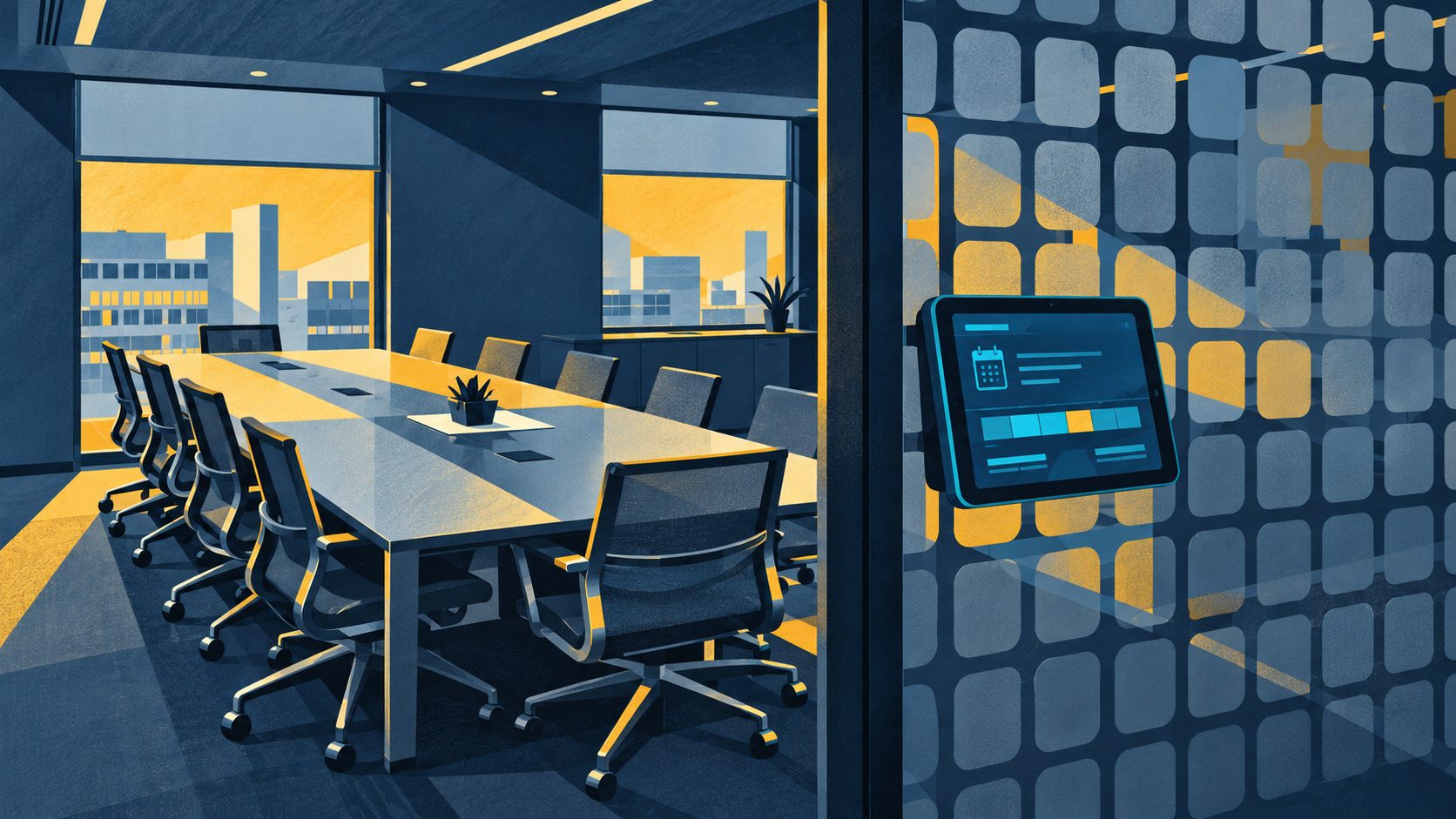
There is little point creating an effortless journey into the office if the meeting itself becomes the frustrating part of the day. We’ve all experienced meetings delayed because someone can’t connect their laptop, the camera won’t work or the room takes five minutes to join a Microsoft Teams call.
These small frustrations quickly undermine the experience organisations are trying to create.
Meeting room technology should feel intuitive. Whether someone is joining a Teams meeting, sharing content wirelessly or connecting their own device, the process should be simple, consistent and reliable.
Increasingly, organisations are also monitoring meeting room technology proactively, identifying faults before users even notice them. That’s when workplace technology stops being reactive and starts delivering genuine value.
Data is shaping the workplace of the future
One of the greatest opportunities created by hybrid working is data. For the first time, organisations can understand how their workplaces are really being used.
Which desks are most popular?
Which meeting rooms are rarely booked?
What days experience peak occupancy?
Are visitors concentrated in particular locations?
This insight allows businesses to make informed decisions about future investment, office design and real estate strategy. Rather than making assumptions, leaders can adapt their workplaces based on real evidence.
Technology should become invisible —
When people hear the phrase frictionless office, they often imagine a workplace filled with technology.
I believe the opposite is true. The best workplace technology is almost invisible.
Employees shouldn’t have to think about booking a desk.
Visitors shouldn’t wonder where to go.
Meeting rooms shouldn’t require technical support to start a call.
Facilities teams shouldn’t spend their time solving avoidable workplace frustrations.
Technology should quietly remove barriers so people can focus on what they came into the office to do: collaborate, innovate, build relationships and work together.
Post-COVID, businesses have rightly challenged how much office space they need. The next challenge is making that space work harder. Because a frictionless office isn’t defined by how much technology it contains. It’s defined by the fact that nobody notices the technology at all — they simply notice that everything works.

Rebecca McCartney is Managing Director of Clear Visual Communications (ClearVC), a leading workplace technology and AV integration specialist.
Having joined the business in 2012, Rebecca has played a key role in its growth from a small team into a nationally recognised integrator delivering collaboration, communication and workplace technology solutions across the UK.