
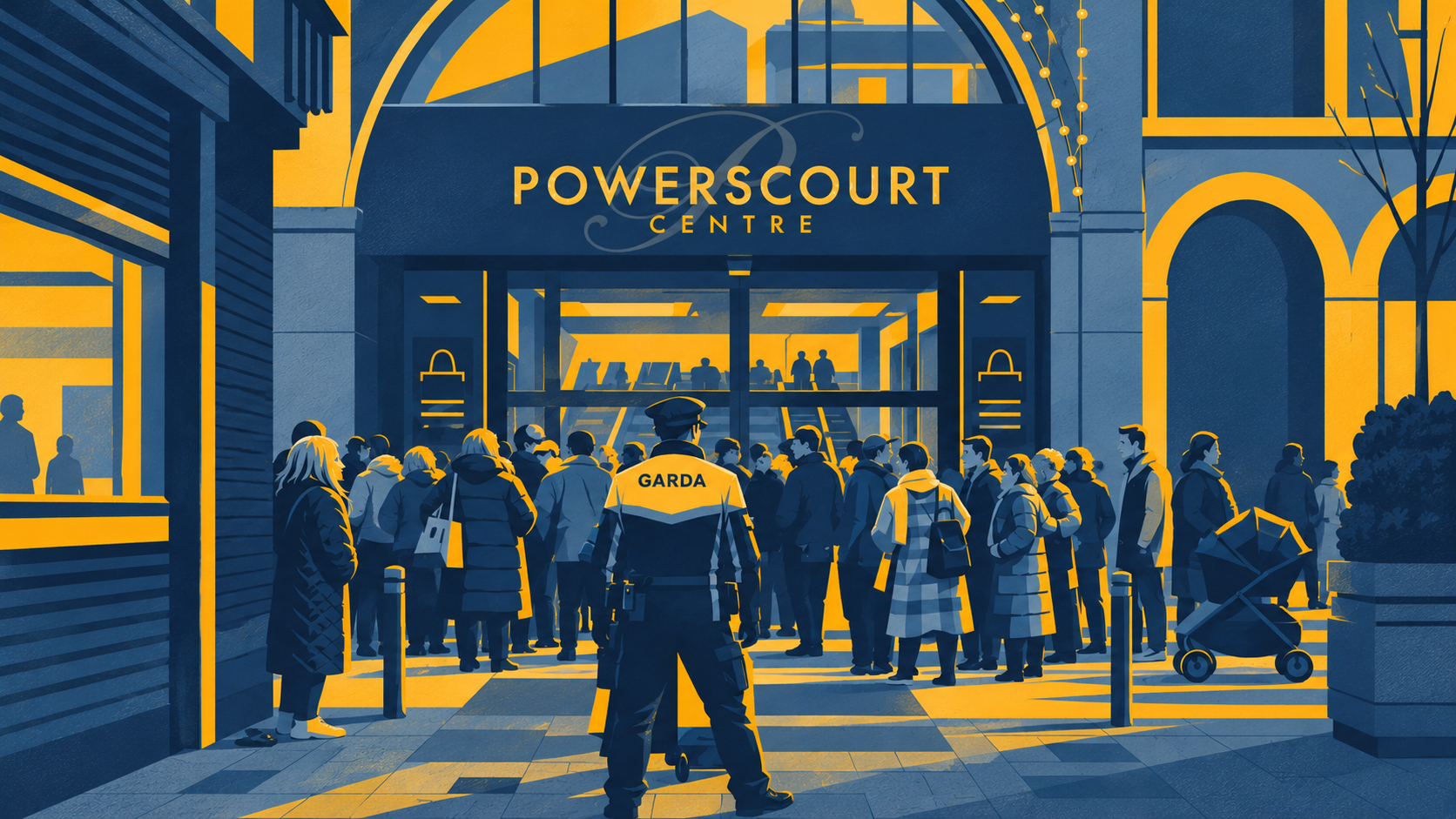
Concerns about safety and anti-social behaviour in Dublin city centre are affecting employees’ working arrangements, client meetings and business location decisions, according to a survey conducted by Dublin Chamber. Just over half of respondents believed that safety had deteriorated over the past year, bringing the economic effect of perceptions about the city centre into sharper focus.
Dublin Chamber‘s Q3 2026 Business Outlook Survey collected views from more than 200 companies across the Dublin region between 25 August and 18 September. Fifty-one per cent said city centre safety had worsened compared with twelve months earlier, 37% felt conditions were broadly unchanged and 11% reported an improvement.
The Chamber said approximately one in three respondents linked safety concerns to employees’ willingness to work in or travel to the city centre. A separate 26% reported consequences for willingness to work during early morning or evening periods. These responses concern the views and reported experiences of participating businesses, not a direct measure of crime rates or public transport incidents.
Almost a quarter, 24%, reported an effect on their ability or willingness to host clients, meetings or events in the city centre. A further 21% said safety concerns influenced office or business location decisions, while 18% identified an effect on security or operating costs. These findings suggest business consequences beyond employees’ individual commuting choices.
Stephen Browne, head of public affairs at Dublin Chamber, said people needed confidence when travelling to work, visiting clients and spending time in central areas. He called for a sustained visible Garda presence together with attention to lighting, street maintenance, vacant properties and derelict sites. The chamber also urged coordination between national government, Dublin City Council and An Garda Síochána.
A city’s commercial centre depends on interaction between office staff, service businesses, retailers, hospitality venues and transport providers. If people avoid particular journeys or reduce time spent in the area, the effect can reach beyond the organisations directly employing them. A decision to hold meetings elsewhere may reduce demand for cafés, meeting spaces, taxis and other local services.
Employers may respond to perceived safety problems by reviewing travel arrangements, shifting working hours or providing additional security. Such measures can improve staff confidence, but may also increase expenditure and reduce flexibility for companies that depend on early starts, late finishes or in-person customer contact. The survey does not quantify the total financial cost of these responses.
Location decisions are particularly significant because offices and high-street premises involve commitments extending well beyond a single trading period. If organisations change how they assess the attractiveness of a site, landlords and neighbouring businesses can experience secondary effects. At the same time, a minority of respondents reporting location impacts should not be taken to mean that Dublin is experiencing a general business exodus.
Business confidence in the public realm is influenced by several factors, including policing, cleanliness, building maintenance, lighting and perceptions shaped by incidents in particular places or at certain times. The chamber’s recommendations therefore extend beyond enforcement to the design and upkeep of streets. Evaluating the success of any response would require both objective public safety data and repeated measures of how workers and employers feel.
Changes in working patterns can further complicate interpretation. Fewer office workers on a particular day may reflect hybrid-working arrangements, transport reliability or business restructuring as well as safety concerns. To identify the scale of any safety-related economic effect, policymakers would need consistent evidence over time and comparison with locations facing similar market conditions. The survey supplies a useful starting point but not that causal analysis.
The findings provide a business perspective on an important issue for Ireland’s capital, although the survey is not necessarily representative of every Dublin employer or resident. With more than 200 companies taking part, it offers useful insight into corporate concerns. Further comparison with official crime, footfall and investment data would help establish how perceptions relate to wider economic outcomes.


You must be logged in to post a comment.