
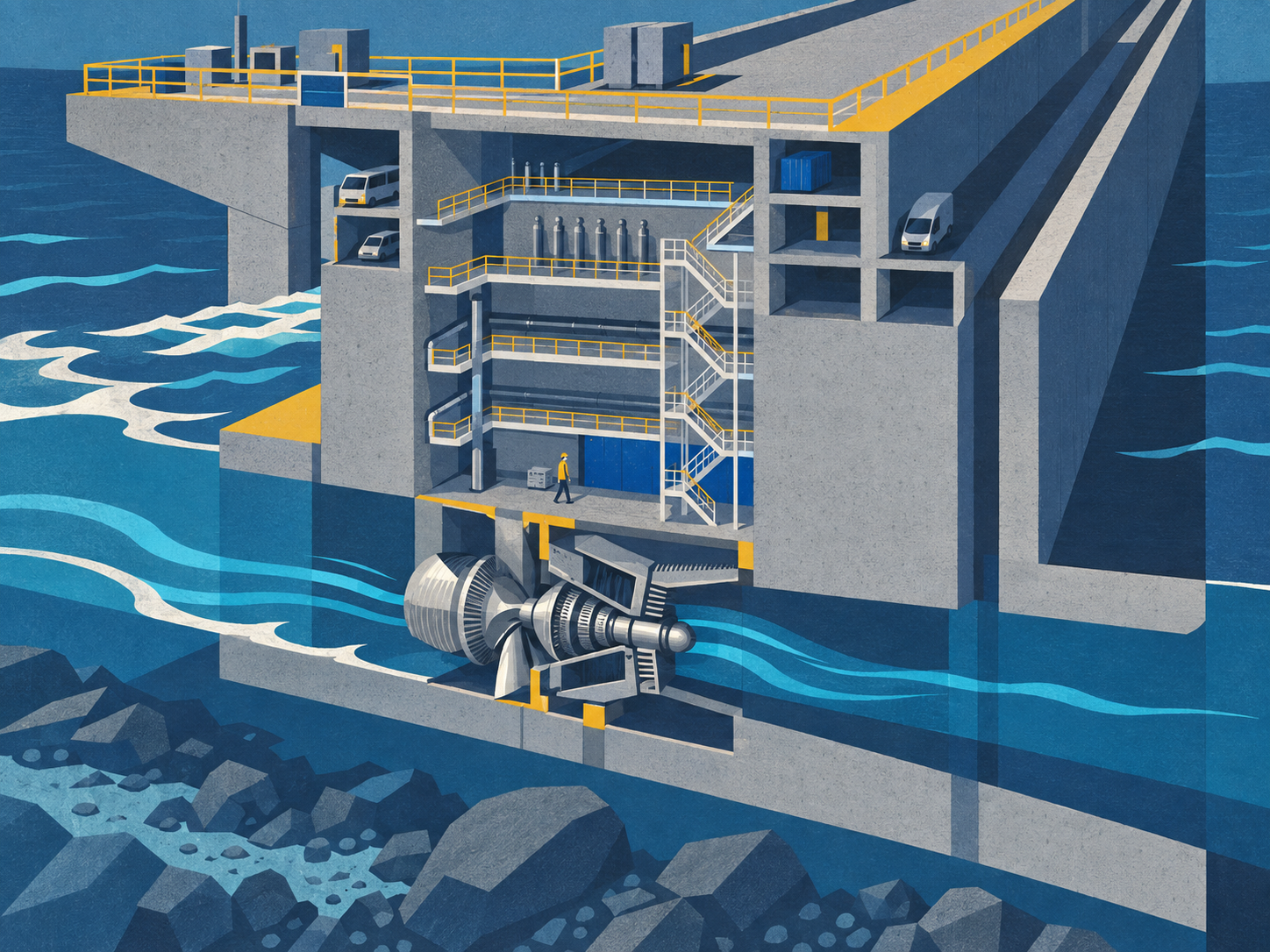
Cardiff Capital Region has committed up to £6.4m to investigate the feasibility of a tidal lagoon in the Severn Estuary, starting a three-year programme of environmental, engineering and commercial work around a potential project at Aberthaw in South Wales.
The regional economic development body has approved exploratory development studies for a scheme that, on initial estimates, could generate around 600MW of predictable renewable electricity. That would be sufficient to supply the equivalent of roughly half a million homes, although the project remains at an early stage and no decision has been made to proceed with construction.
The funding will come from City Deal resources and support environmental assessment, engineering design, modelling and commercial analysis. Aberthaw and its surrounding area have emerged as the preferred location following work between Cardiff Capital Region and the West of England Mayoral Combined Authority, drawing on recommendations from the independent Severn Estuary Commission.
Cardiff Capital Region estimates that a completed lagoon could generate around £3.5bn in economic value, support thousands of jobs and create work for companies across engineering, construction, marine technology and associated supply chains. It has also suggested that the infrastructure could operate for more than 120 years.
Cllr Mary Ann Brocklesby, chair of Cardiff Capital Region, said: “The Severn Estuary has one of the highest tidal ranges in the world, with the potential to generate predictable, homegrown renewable energy that complements existing wind and solar power.”
The development programme now has to establish whether those headline estimates survive detailed technical and environmental scrutiny. The Severn is an internationally significant ecological environment, so issues including habitats, sediment movement, fish populations and changes to tidal flows will form part of the engineering work rather than being treated as secondary considerations once a design is fixed.
Tidal range has long occupied a distinctive position in UK energy policy. Unlike wind and solar output, tidal cycles can be forecast far in advance. That predictability could help balance a power system containing larger volumes of intermittent renewable generation, but tidal infrastructure also brings high upfront capital costs and long development periods.
The economics will have to be tested against a UK electricity market that is already absorbing major investment in offshore wind, grid reinforcement and storage. A commercially viable tidal lagoon would need to demonstrate not only that it can generate reliably, but that the cost of its electricity justifies the construction and financing required for a major marine engineering project.
Developers will also need clarity over how construction risk and future revenues would be allocated. Long-lived infrastructure can deliver economic value over several generations, but investors still require an acceptable return during the period in which capital is committed and construction risk is at its highest.
The Aberthaw proposal is intended to establish evidence for more than a single project. Cardiff Capital Region believes a successful demonstration lagoon could help unlock a wider sequence of schemes across the Severn. The broader tidal resource has been estimated at up to 5GW of generating capacity, equivalent to the electricity consumption of as many as four million homes.
A programme on that scale would have different industrial consequences from a one-off development. Repeated projects could give suppliers greater confidence to invest in specialist equipment, marine engineering capacity and skills, while creating a more durable domestic market for companies able to support construction and long-term maintenance.
Aberthaw itself has a long association with energy production, giving the area existing industrial infrastructure and workforce experience. The exploratory work will determine how much of that legacy can be used by a tidal development and what additional grid, transport and marine infrastructure would be required.
The £6.4m commitment therefore represents development capital rather than approval for a multibillion-pound lagoon. Its immediate purpose is to establish whether the environmental constraints, engineering requirements and commercial assumptions can be reconciled. If they can, the work could provide the evidence base for one of the UK’s larger new renewable infrastructure propositions.


You must be logged in to post a comment.