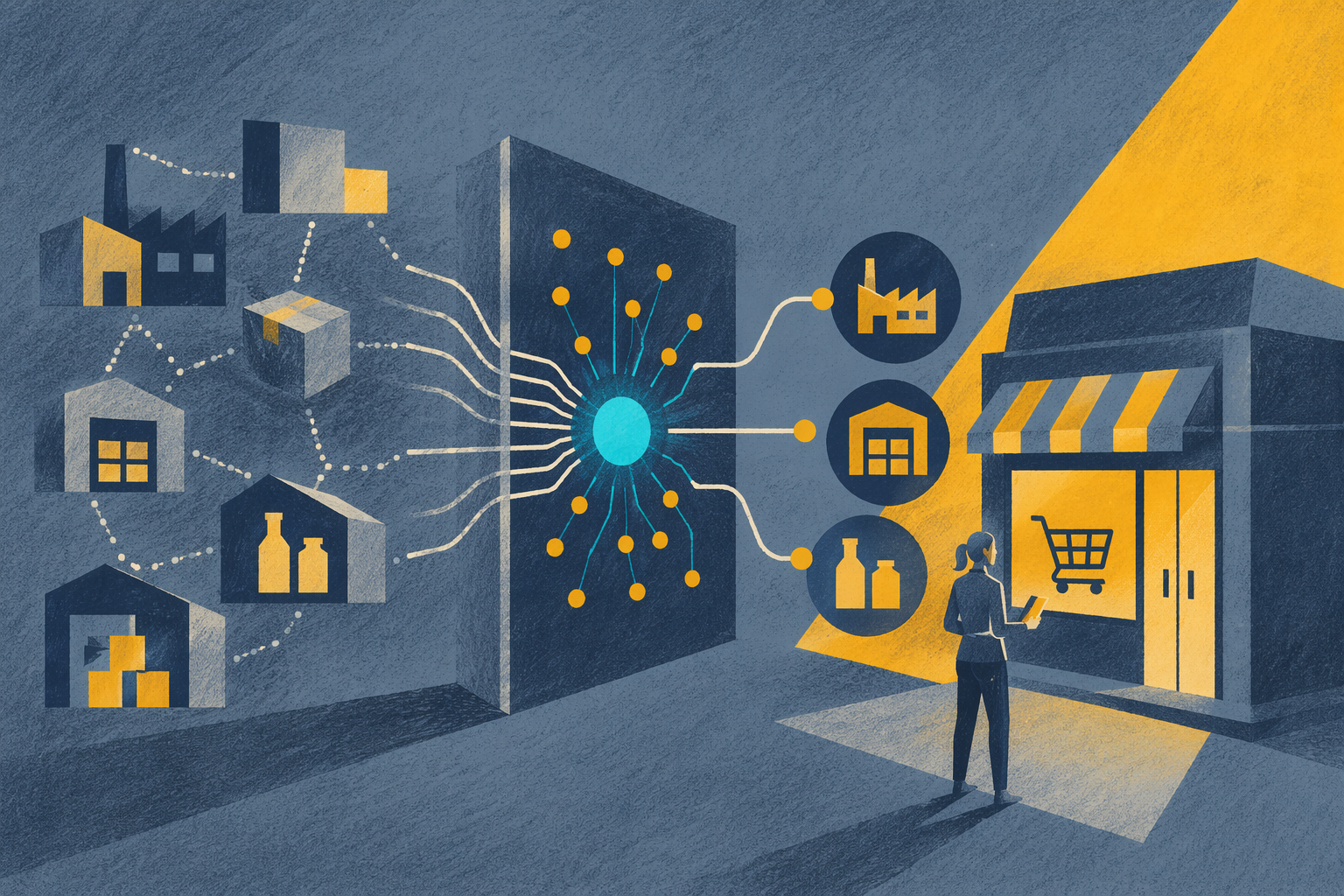
Ocado Group and Asda have agreed an ecommerce partnership that will see Asda use the Ocado Smart Platform to upgrade its online grocery business across the UK from 2027.
The companies said the partnership will focus on quickly replacing and upgrading Asda’s existing ecommerce infrastructure, with Ocado’s solutions set to be rolled out across stores and dark stores. The technology will cover Ocado’s front-end webshop, in-store fulfilment tools, and software supporting last-mile planning and route efficiency.
Asda will use the platform to support a full range of online services, including scheduled orders, short lead-time orders, and click and collect. The platform will also be used to fulfil and deliver orders placed through aggregator platforms including Uber Eats, Deliveroo, and Just Eat.
Asda is one of the UK’s largest retailers, with total sales of more than £21bn in 2025 and operations across around 1,100 stores. The company also operates a substantial online grocery business, fulfilling more than 700,000 ecommerce orders a week through its network of stores and dark stores.
The companies said they will work together over the coming months to enable the platform to go live in early 2027. Ocado said the transaction is not expected to have a material financial impact in FY26, but the group still expects to turn cash-flow positive during the second half of this financial year and for the full year in FY27.
Tim Steiner, chief executive of Ocado Group, said the UK remains “one of the world’s most competitive and fast-evolving online grocery markets”.
Allan Leighton, executive chairman of Asda, said continued success depended on “providing a positive experience for customers every time they shop”.
The agreement gives Asda a route to improve digital performance while it works to strengthen its competitive position in a market dominated by Tesco and Sainsbury’s at the top and pressured by Aldi and Lidl on value. Online grocery remains a key battleground because it affects customer frequency, loyalty, delivery economics, and perception of service quality.
Ocado, meanwhile, reinforces its position as a grocery technology supplier as well as a retail brand through the Ocado Retail joint venture with Marks & Spencer. Its technology already supports partners internationally, and the Asda agreement gives it another large UK customer at a time when investors are scrutinising the pace and economics of platform growth.
Grocery ecommerce is one of the most demanding areas of retail technology. It combines low-margin products, high basket complexity, substitutions, temperature controls, tight delivery windows, driver routing, store picking, warehouse processes, customer service, and rapidly changing demand. A better front-end experience is only part of the test. The platform also needs to improve the accuracy, availability, and economics behind each order.
The partnership reflects a wider shift in customer experience, where the line between retailer, technology provider, and logistics operator is becoming less distinct. Customers judge online grocery by search quality, product availability, delivery reliability, substitution handling, refunds, and basket value. Each of those points is shaped by systems that sit below the visible website or app.
That shift is accelerating as AI moves deeper into grocery shopping, with consumers increasingly using intelligent tools before they reach retailer platforms. Retailers facing that behaviour need infrastructure that can respond with relevant search, stable fulfilment, and reliable delivery capacity.
The aggregator element is also important. By supporting orders through Uber Eats, Deliveroo, and Just Eat, Asda is acknowledging that grocery demand is increasingly split across missions. Some customers still plan large weekly shops, while others expect fast top-up delivery, convenience ordering, and flexible fulfilment. The economics of those channels differ sharply, and retailers need systems that can manage service promises without eroding margin.
Asda’s online operation is already large, but scale alone does not guarantee advantage. Online grocery growth can expose operational weaknesses quickly if picking accuracy, stock data, routing, or checkout stability are inconsistent. Improvements in fulfilment efficiency and customer experience can support retention even in a price-sensitive market.
The deal also shows how large retailers are weighing build-versus-partner decisions. Developing and maintaining proprietary ecommerce infrastructure can be expensive, slow, and risky, particularly when customer expectations and delivery models are changing quickly. Partnering with a specialist platform can reduce execution risk, but it also creates dependence on external technology. The balance between speed, control, cost, and flexibility will shape whether the partnership delivers lasting advantage.
Price and range remain central to grocery competition, although digital reliability is now part of the core proposition. As the sector faces cost pressure, labour constraints, and more fragmented shopping behaviour, online experience and efficient fulfilment are becoming harder to separate from loyalty and margin protection.