
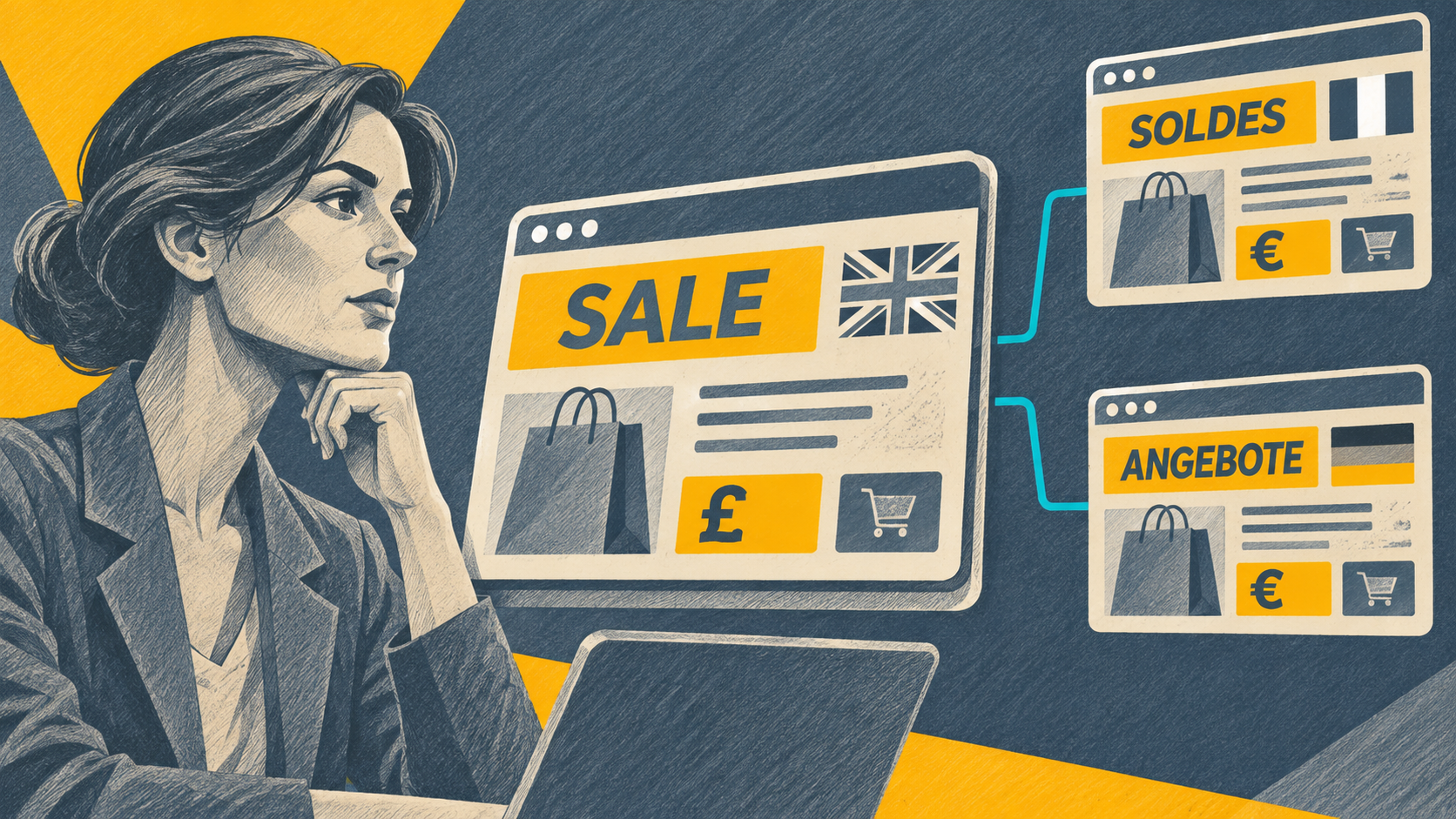
Peak season starts earlier than many SMEs expect, with 60% of Black Friday shoppers beginning to browse by October. And the opportunity is not limited to local customers. Research from FedEx found that internationally trading UK SMEs expected 38% of their festive sales during the 2025 holiday season to come from outside Europe.
To maximise success during this busy period, businesses often rush to build tailored landing pages, promotions, and product content ahead of major events such as Black Friday and Christmas. For smaller retailers, preparing campaigns for international audiences adds another layer of complexity. New landing pages need to be launched quickly, translated accurately and updated whenever prices, stock, delivery deadlines or promotional terms change.
But speed can create avoidable problems. When the focus is simply on going live, cluttered layouts, unclear messaging, slow load times, and disconnected customer journeys can undermine an otherwise strong campaign.
To convert peak-season demand, businesses need to treat each campaign page as a product and plan for localisation, multilingual SEO, and ongoing updates from the start. This helps SMEs reach the right customers, keep offers accurate, and make the most of their campaign investment.
Why landing pages fail before the campaign does —
For international campaigns, the landing page needs to carry through the language and offer that brought the customer there, with a clear route to purchase. Any break in that continuity introduces friction and can weaken the customer’s confidence in the offer.
The disconnect can happen at any stage between the advert and checkout. A French shopper might click on a Black Friday offer promoted in French and reach a translated landing page, only to find that the product information or delivery terms are still in English. They then have to switch languages to check what they’re buying or whether it will arrive in time, making it harder to complete the purchase.
A landing page should guide visitors towards a clear action, whether that’s making a purchase, exploring a product, or signing up for an offer. Understanding the audience and what they need to make that decision is essential to creating a page that does its job.
Build for international audiences from the start —
Localisation is most effective when it is considered at the start of the page creation process rather than added as a final step. Translating the copy is only part of the task. Currencies, delivery information, examples, offers, imagery, dates, and messaging may all need to be adapted so the page feels relevant to the target market.
This also affects how easily international customers can find campaign pages. Google recommends giving each language version its own URL, rather than relying on cookies or browser settings to change the language displayed. Hreflang annotations help it show the appropriate language or regional version in search results. These pages can sit under the same domain, with /fr/ and /de/ as examples of language subdirectories, rather than requiring separate websites for every market. For seasonal campaigns, language versions need to be published well ahead of peak demand to allow time for discovery, crawling and indexing, rather than waiting until the promotion begins.
A simple framework across markets —
One of the biggest challenges comes after launch. As products, promotions and prices change throughout the season, campaign pages need to be updated accordingly.
Without a clear workflow, landing pages can quickly become inconsistent. When a promotion, price or delivery deadline changes, teams should identify which language versions are affected, update the relevant translations and then review the most important details in the context of each page. Before the change goes live, they can check that the right offer, price and messaging are appearing in each market.
Teams should therefore prioritise the markets, languages and products with the greatest sales potential, giving attention to high-impact assets such as campaign landing pages, key product pages and homepage banners. A shared glossary can help keep product names, promotional terms and campaign terminology consistent across languages, while clear tone and brand guidelines help preserve the brand’s voice. Both are important: the translated offer needs to be accurate, but it should also sound like the same brand in every market.
However, consistency is not only about the words being used. While a translation may be accurate, it may be too long for a button, banner or mobile layout. Reviewing translations in the context of the landing page can help teams catch these issues before customers encounter them.
Automation can take some of the repetitive work out of this process. Translations can be updated as source content changes, while human review is focused on the parts of the page where context matters most. This is particularly useful for small teams managing several language versions, as they don’t need to manually recheck every piece of content after every change.
The goal is not to create more work, but to establish a repeatable process that allows small teams to launch and scale campaigns across multiple markets without losing control or adding unnecessary complexity.
Building for long-term performance —
Seasonal landing pages may be temporary, but the customer impression they create can have a lasting impact on campaign performance. Poorly localised or outdated content can undermine trust, while a well-managed experience gives international visitors a clearer path to conversion.
By building localisation, multilingual SEO, and content workflows into the planning process from the start, SMEs are better positioned to reach international audiences and maintain consistency as campaigns evolve.
The most effective landing pages are not simply the fastest to launch. They are the ones that remain relevant, discoverable, and easy to manage throughout the entire campaign lifecycle.

Eugène Ernoult is the Chief Marketing Officer at Weglot and host at Next Market Live – The Podcast. He was the co-founder of a kid-friendly language learning app called Pili Pop, where he learned about business development, customer acquisition, and international growth.



You must be logged in to post a comment.