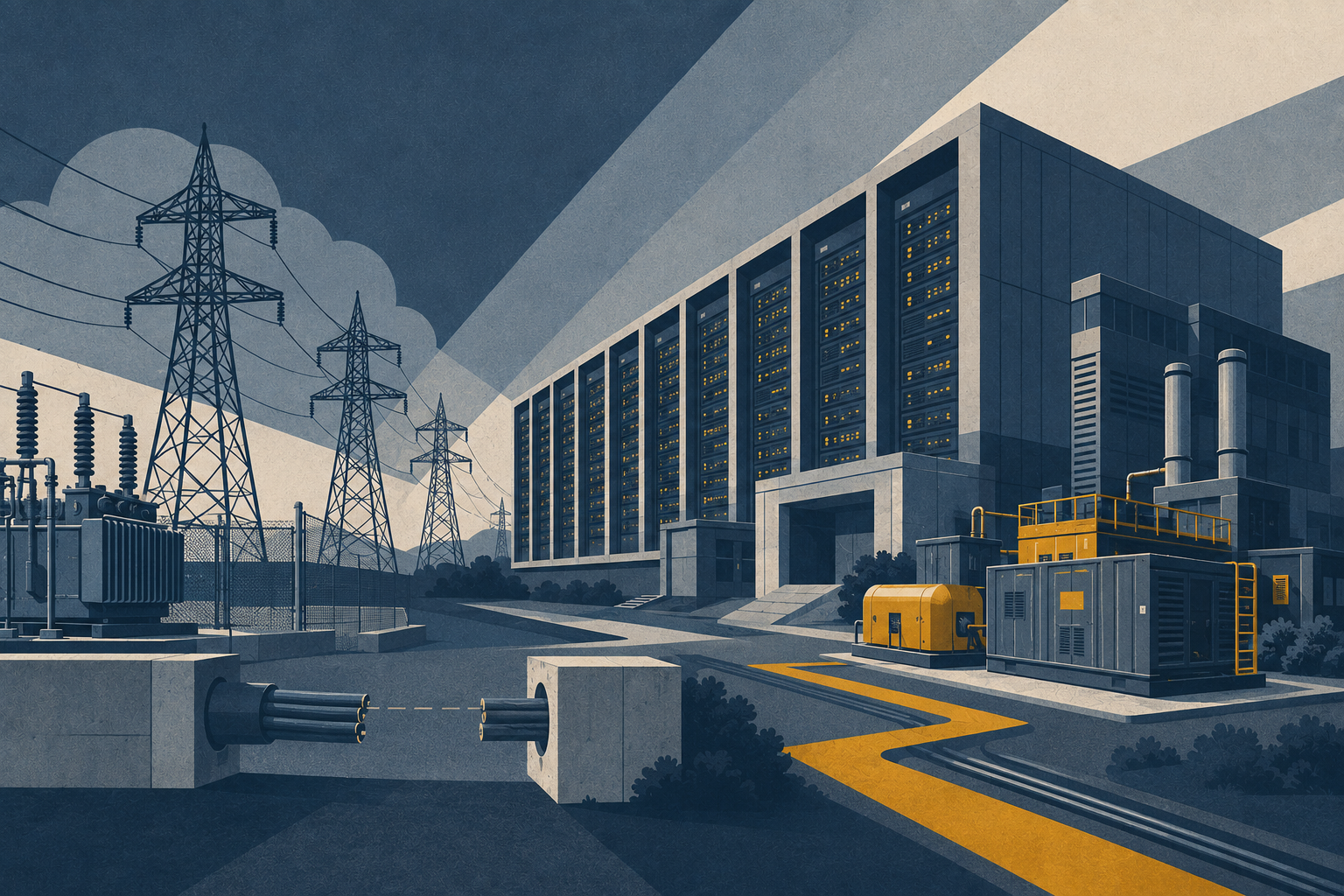
Delays in securing a grid connection are forcing Nscale to examine alternative power arrangements for its planned £2bn artificial intelligence data centre campus in Loughton, Essex, exposing the infrastructure constraints behind the UK’s efforts to expand domestic computing capacity.
The site was announced as a 50MW facility capable of scaling to 90MW, with advanced liquid cooling and capacity for tens of thousands of high performance graphics processing units. It is intended to support large artificial intelligence workloads and form part of Nscale’s wider partnership with Microsoft for additional UK cloud infrastructure.
Operations were originally expected to begin during 2026, while a later Microsoft commitment involved an initial deployment of 23,040 Nvidia GB300 graphics processing units from the first quarter of 2027. Uncertainty over the grid connection now raises questions about how the site will be energised within its construction and customer timetable.
Nscale said: “We remain fully committed to the Loughton project.”
The company is exploring alternative sources of electricity, including forms of generation located at or near the site, while it continues to pursue a permanent grid connection. An interim arrangement could allow the facility to begin operating earlier, although it would add questions around capital cost, fuel supply, emissions, planning, resilience, and the later transition to grid power.
Demand for advanced computing capacity has risen sharply as technology companies, research organisations, government bodies, and large enterprises train and operate more complex models. Dense clusters of specialist chips require substantial and continuous electricity, with further demand created by cooling, networking, storage, and backup systems.
Grid access increasingly determines where data centres, advanced manufacturing plants, battery projects, and electrified industrial facilities can be built. Connection dates can fall years beyond the construction programme for the underlying site, creating a mismatch between commercial investment cycles and network reinforcement.
Recent reforms intended to accelerate decisions on major infrastructure projects address only one part of the problem. A development may secure planning permission and complete construction, yet remain unable to operate at full capacity without sufficient generation, transmission, and local network infrastructure.
Artificial intelligence campuses place unusual pressure on the system because their demand is concentrated and can increase quickly as additional halls are commissioned. A 90MW site represents a substantial continuous load, while operators also require redundancy and multiple supply routes to protect expensive equipment and customer services.
On-site generation can bridge a delay, but the environmental and commercial profile depends on the technology selected. Gas generation may provide dependable output while increasing direct emissions. Fuel cells can reduce some local pollutants depending on the fuel, and batteries can support resilience without creating electricity themselves.
Renewable generation may contribute to the supply mix, although the consistency and scale required by a large data centre are difficult to provide entirely within the site boundary. Long-term power purchase agreements can support additional capacity elsewhere, but new projects still depend on planning, grid access, and construction.
Those trade-offs complicate climate commitments across the technology sector. Companies may contract for renewable electricity while their facilities continue placing additional demand on local grids, particularly during periods when low carbon generation is not available.
Grid uncertainty also affects project finance. Data centre valuations depend on deliverable megawatts, contracted customers, equipment availability, and construction milestones. A site with planning consent but no dependable energisation date carries a different risk profile from one with secured power, regardless of underlying demand for compute.
The UK is competing with European, North American, Middle Eastern, and Asian markets for artificial intelligence infrastructure. Land, technical skills, fibre connectivity, planning, tax treatment, and political support all influence location decisions, but electricity availability is becoming one of the hardest constraints to overcome quickly.
Local considerations will remain prominent. Large facilities can create construction work, technical employment, business rates, and improved digital infrastructure, while also generating concern about power allocation, water use, noise, visual impact, and the number of permanent roles created after construction.
Alternative generation may itself require planning approval, environmental assessment, fuel contracts, and additional network equipment. A temporary solution can therefore become a substantial project rather than a simple bridge to the eventual grid connection.
Coordination between developers, network operators, local authorities, government, and energy suppliers will determine whether facilities can progress at the pace promised by investment announcements. Connection reform may need to distinguish between speculative projects and developments with committed capital, customers, and construction programmes.
Nscale’s ability to secure reliable power without undermining cost, resilience, or environmental commitments will determine whether the Loughton timetable can be recovered. The project has become a test of whether national artificial intelligence policy can be matched by energy infrastructure capable of supporting it.
Demand for computing capacity remains strong, but the physical systems beneath it cannot be expanded at the speed of software. Grid reinforcement, new generation, clearer connection priorities, and realistic development timetables will shape which projects proceed and which are diverted to better supplied markets.