
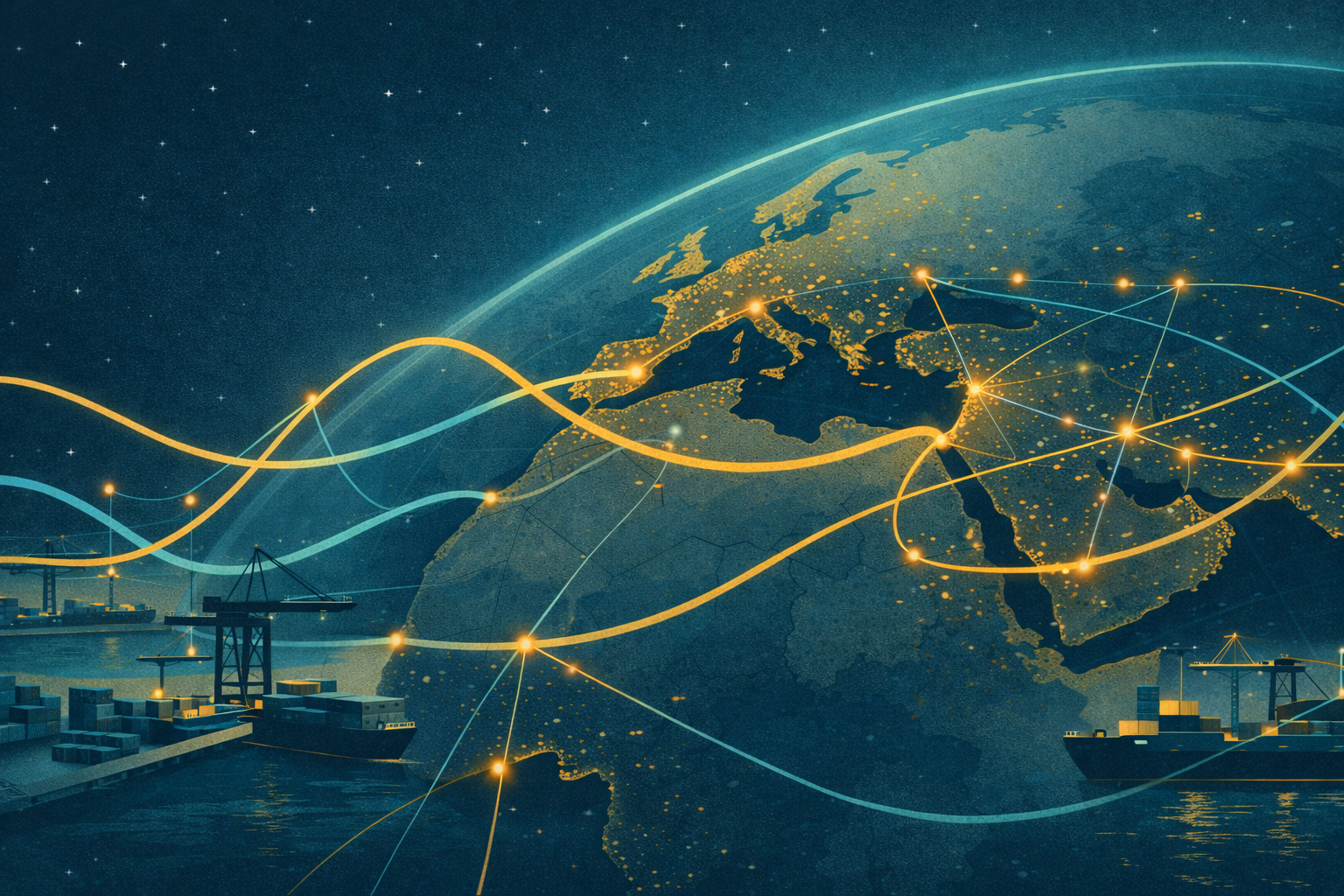
The Government Office for Science has expanded its work on global supply chain resilience with new modelling detail showing how disruption at individual companies or countries can propagate through interconnected production networks.
The material published on 24 September is an additional technical annex to the Government’s Global supply chains: a foresight report on risk and resilience, first released on 15 June. The update is not a new policy or a new edition of the underlying report.
Annex B instead sets out the agent-based modelling methodology used to examine how supply chain shocks could move between businesses and across borders, alongside the quantitative framework used for the report’s longer-term scenarios.
The modelling starts from the premise that supply chains operate as networks rather than simple linear sequences. A disruption affecting one company can reduce inputs available to its customers while also reducing orders placed with suppliers further upstream.
Those effects can compound when a business occupies a critical point in a production network, even if the company itself is not particularly large. The methodology therefore looks beyond direct imports, exports, and first-tier supplier concentration to examine the position businesses occupy within wider networks.
The Government Office for Science uses an Economic Systemic Risk Index to explore the reduction in production associated with the complete disruption of a company, region, or country. The model distinguishes between the effect on the overall international network and the impact specifically on UK businesses.
The underlying supply network is built from company and transaction-level data held through the Government’s Global Supply Chain Intelligence Programme. The commercial dataset combines information including international trade documentation, logistics records, company locations, and sector classifications.
Five years of data from January 2020 to December 2024 are used to map relationships. The longer period is intended to capture supply arrangements that may not appear every year, including backup suppliers used only when regular sourcing is disrupted.
The model deliberately applies severe assumptions when testing disruption. A company or country subject to a simulated shock can be treated as losing all production capacity, allowing researchers to examine how the effect spreads through connected businesses.
The output should not be interpreted as a forecast of what would happen during a real disruption. The model does not fully represent inventories, transport delays, the ability of businesses to redesign products, or every way companies might switch suppliers or alter operations in response to shortages.
Some of those exclusions make the stress test deliberately conservative. Limiting the ability of businesses to substitute unavailable inputs can produce stronger cascading effects than might occur where companies hold adequate stock, have alternative suppliers, or can modify production.
The methodology nevertheless exposes an important weakness in conventional supply chain risk management. Direct supplier concentration is comparatively straightforward to identify. Indirect dependency is harder: a UK business may buy from several immediate suppliers while all of them depend on the same upstream producer, transport route, country, or specialist input.
Such concentrations became more visible during pandemic disruption and subsequent shortages affecting semiconductors, shipping, energy, and other essential inputs. The new technical material provides a framework for examining similar vulnerabilities at network level rather than treating each company’s direct supply base in isolation.
The annex also explains six headline metrics used to compare four illustrative global supply chain scenarios extending towards 2040. They cover global trade intensity, UK trade integration, climate shock exposure, societal readiness for climate adaptation, global trade cooperation, and alignment with trusted trade partners.
The Government Office for Science repeatedly cautions that the scenario values are not predictions. They combine historical data, quantitative extrapolation, and expert judgement to illustrate how different geopolitical, trade, and climate conditions could affect supply networks.
That approach mirrors scenario analysis increasingly used in corporate risk planning. The value lies less in assuming a particular shock will unfold exactly as modelled than in identifying where an organisation is unusually dependent on a supplier, product, geography, or connection that normal procurement data may not reveal.
Larger businesses may respond by mapping beyond tier-one suppliers. Smaller organisations, with less leverage over suppliers and fewer resources for detailed analysis, can encounter the same exposure through shortages, longer lead times, higher prices, or sudden loss of access to specialist components.
The September update adds methodological transparency rather than a fresh warning or policy intervention. It shows how government analysts are attempting to quantify systemic supply chain exposure at company level and why network position can make an apparently modest supplier disproportionately important when disruption spreads.


You must be logged in to post a comment.