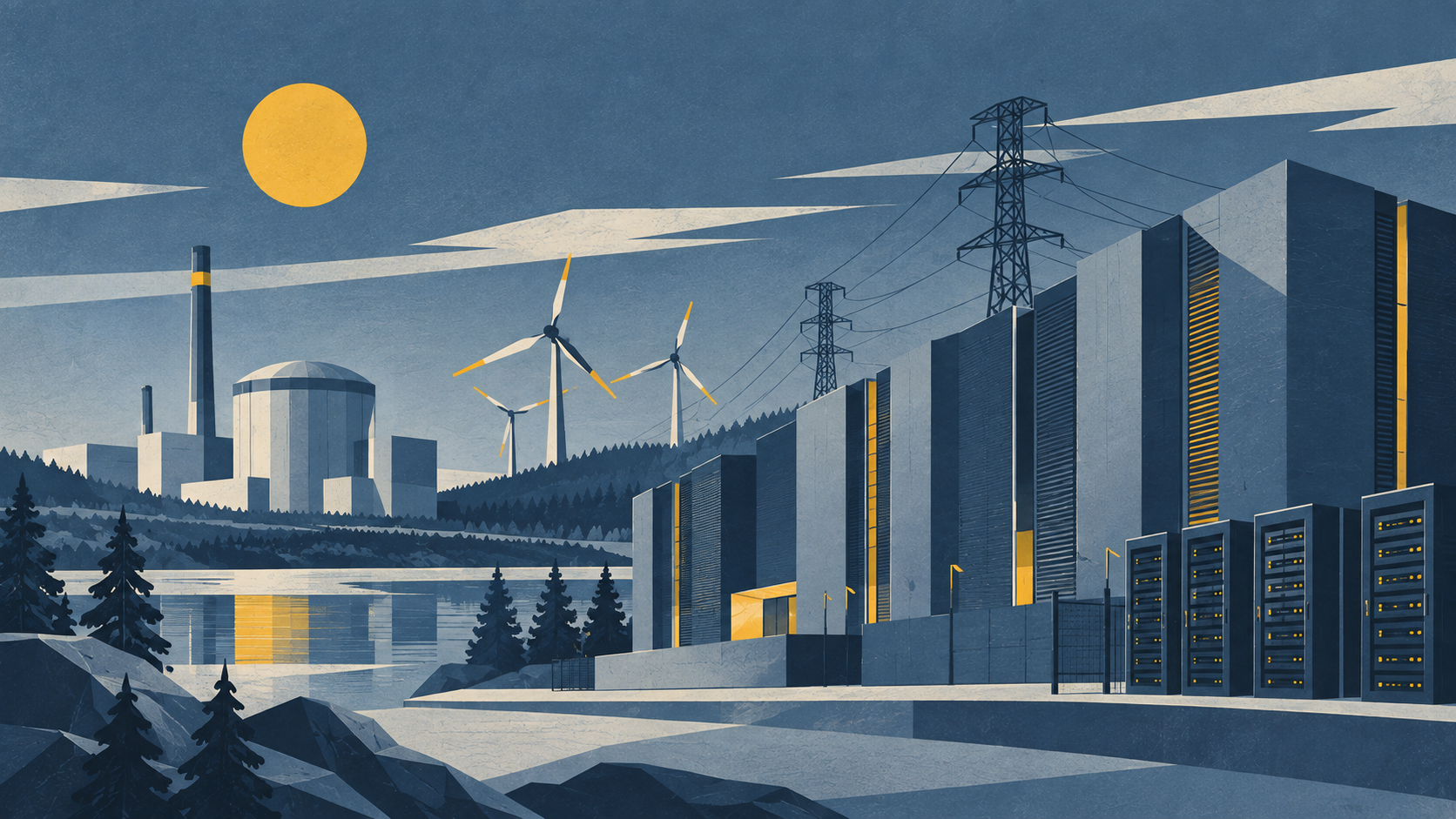
Google is committing €13bn to digital and artificial intelligence infrastructure in Finland over 2027 and 2028, combining its largest single European investment with long-term agreements covering nuclear power, wind generation, battery storage, and grid capacity.
The programme will span Hamina, Kajaani, Muhos, and Vaala, expanding a Finnish presence that began with Google’s Hamina data centre 15 years ago. The company expects construction associated with the investment to support more than 37,000 jobs nationwide during 2027 and 2028 and contribute €3.6bn annually to Finnish GDP during that phase.
Once fully operational, the new facilities are expected to support thousands of permanent jobs across engineering, security, catering, facilities management, and other functions. Google is also allocating €31m to communities around the four locations over four years, including AI skills programmes for more than 4,400 workers and training opportunities for 100 Finnish students.
The investment materially strengthens the link between European AI infrastructure and power-market strategy. Google has signed a 22-year power purchase agreement with Finnish energy company Fortum connected to the Loviisa nuclear power plant, providing long-term demand that will support the extension of the plant’s operating life.
Loviisa supplies a significant share of Finland’s electricity and remains an important source of low-carbon baseload generation. The agreement gives Fortum greater revenue certainty as it considers the investment required to keep the plant operating towards 2050.
Google and Fortum have also signed a memorandum of understanding covering possible new nuclear generation, renewable capacity, flexibility services, and energy portfolio management. The companies intend to explore commercial models that could improve the viability of further nuclear investment at Loviisa.
Alongside nuclear power, Google is adding new onshore wind agreements with Valorem and Suomen Hyötytuuli. Those arrangements will take new-to-grid wind capacity supported by the company in Finland to 629MW. A separately contracted 94MW battery installation near Kajaani is expected to enter service in late 2027.
The scale of the package reflects how electricity availability has become a central constraint on AI expansion. Data centres require substantial continuous power, while industrial electrification and wider digital demand are placing additional pressure on transmission networks in several European markets.
Finland offers a combination of relatively low-carbon electricity, cooler temperatures, available land, and grid capacity in northern regions. Locating additional facilities around those connection points can allow infrastructure developers to use existing network capacity more efficiently than in areas where power systems are already congested.
Energy strategy is consequently becoming part of technology-sector location strategy. Hyperscale operators are entering much longer power agreements, supporting new generation, and investing indirectly in storage to secure the electricity needed for infrastructure whose operating lives may extend for decades.
Nuclear generation has become more prominent within that mix because it can provide continuous low-carbon output alongside variable wind and solar power. Long-term contracts can also help utilities finance life extensions or new capacity that would be more difficult to justify solely through wholesale electricity markets.
European governments are competing to attract the investment associated with AI infrastructure because data centres can support construction, engineering, network expansion, tax revenues, and skilled employment. The same projects can create pressure on power systems if generation and transmission capacity do not expand at a comparable pace.
Google’s Finnish programme addresses both sides of that equation. The company is committing capital to computing infrastructure while simultaneously securing generation, battery storage, skills, and community investment around its operating sites.
The facilities will support growing demand for services including Gemini, Search, and Maps. The long-term commercial case will depend on the continued expansion of cloud and AI workloads, but the energy agreements extend considerably beyond the current technology investment cycle.
The 22-year Loviisa agreement in particular ties part of Google’s European infrastructure growth to Finland’s electricity system well into the 2040s. The result is a €13bn programme in which computing capacity and energy security are being planned together rather than treated as separate investment decisions.