
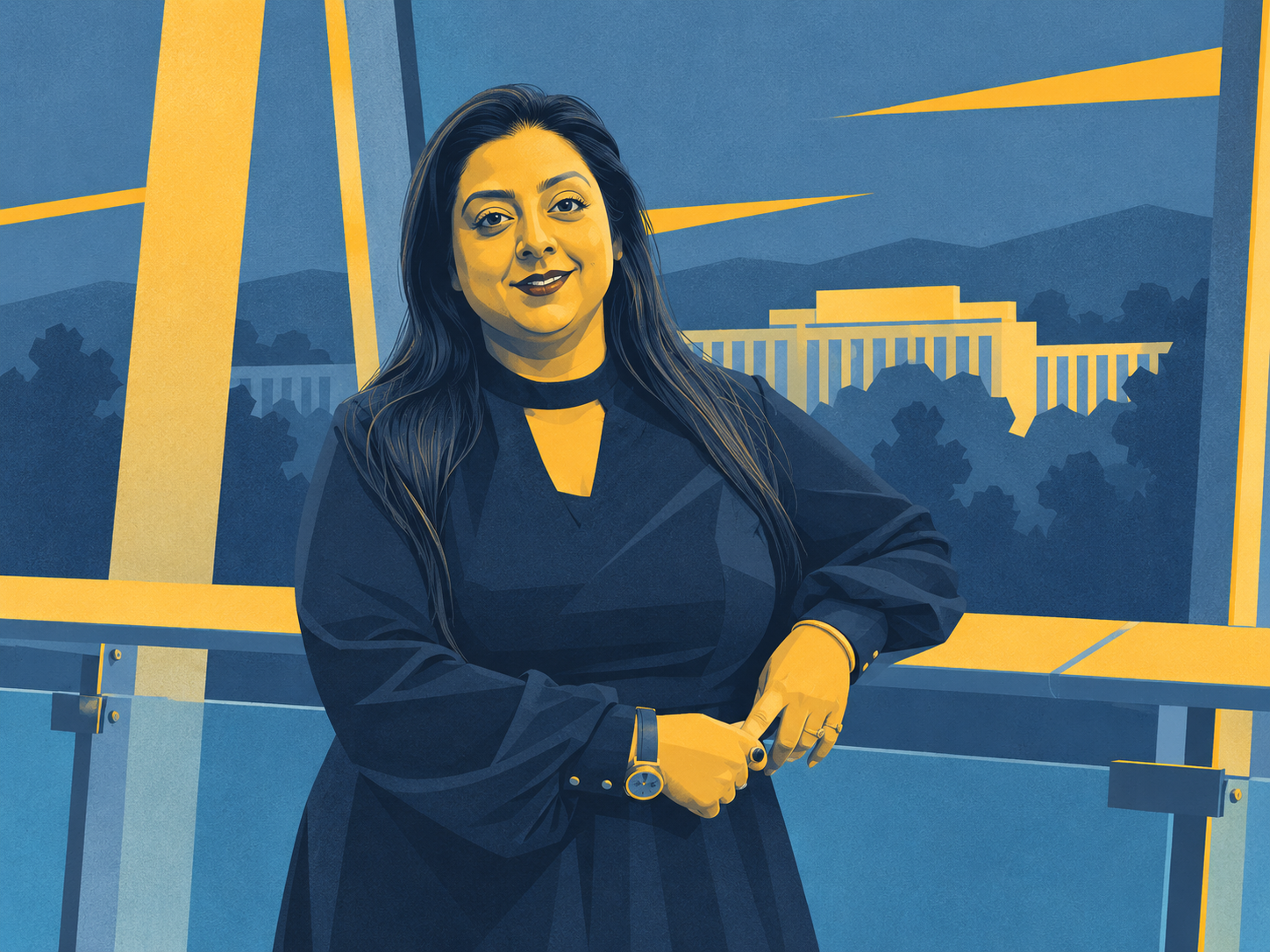
Scottish entrepreneur Veenoo Sharma has launched a six-day accelerator giving 30 women founders funded places inside Dubai’s artificial-intelligence and investment ecosystem, with applications open internationally.
SHE Leads with AI is being delivered through Dubai AI Campus at the Dubai International Financial Centre Innovation Hub in partnership with The Power Diaspora Forum. The programme begins on 16 November and concludes with an investor showcase on 23 November.
Sharma, founder and president of The Power Diaspora Forum, has positioned the initiative as a route for women entrepreneurs to develop practical AI capability while building relationships with investors, venture-capital businesses, family offices and organisations operating in the DIFC ecosystem.
Applicants must lead revenue-generating companies that have operated for at least 12 months and have an existing customer base. Priority sectors include AI and the digital economy, fintech, climate and energy, food security and agri-tech, health technology, space and mobility, and defence and security.
The programme moves from AI foundations and business-use cases into product development, capital readiness, scaling and pitch preparation. One session will use Replit’s AI development tools to help founders create websites, applications, internal tools or automations without conventional software-development processes.
Sharma said: “SHE Leads with AI also creates a direct pathway from the UK into Dubai’s AI, investment and business ecosystem.”
The accelerator reflects increasing competition between international business centres to attract founders before their companies reach substantial scale. Dubai has invested heavily in free zones, technology infrastructure and financial-services ecosystems designed to make the city a base for companies targeting the Middle East and wider international markets.
For UK entrepreneurs, the attraction is partly capital and partly market access. Gulf investors have become increasingly active in international technology, while Dubai offers proximity to customers across the Middle East, South Asia and Africa.
Those opportunities can still be difficult for smaller businesses to navigate. Founders entering a new market need relationships with customers, advisers and potential investors, alongside knowledge of local regulation and procurement. An accelerator can compress some of that network-building, although commercial outcomes depend on relationships continuing after the programme ends.
AI is also altering the economics of international expansion. Small teams can use automation for software development, customer service, marketing and internal administration, potentially reducing the resources required to test a new market.
Technology does not remove the need for local expertise. Businesses selling into Gulf markets still have to understand regulation, customer behaviour and contracting practices rather than assuming a digital product can be transferred unchanged from the UK.
The women-founder focus addresses another established constraint in venture finance. Female founders remain underrepresented in many investment portfolios, while the cost of entering overseas networks can compound difficulties accessing capital.
A six-day accelerator cannot remove those structural barriers. Its value will become clearer through follow-on investment, customer introductions and sustained commercial relationships generated after the investor showcase.
The launch nevertheless adds another route connecting UK-founded businesses with Gulf capital and technology infrastructure. As international financial centres compete for early-stage companies, programmes combining AI capability, investor preparation and market access are becoming part of the wider contest to attract businesses before their geographic footprint is fixed.


You must be logged in to post a comment.