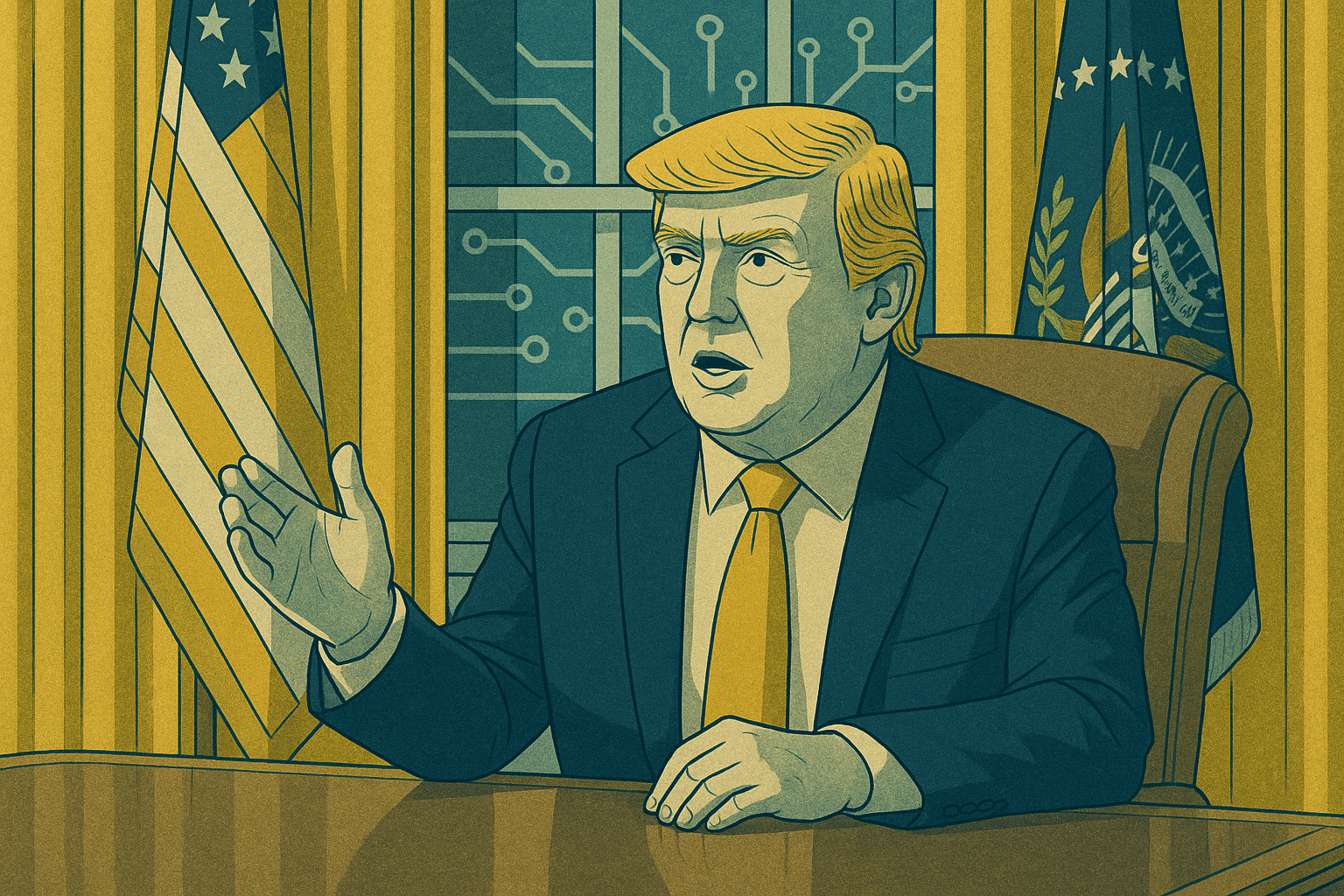
President Donald Trump has called for a single, nationwide standard governing artificial intelligence, warning that state-level regulation threatens to fragment the country’s technology policy and slow progress in a field he called “America’s Growth Engine.”
In a statement published on social media and confirmed by the White House on 18 November 2025, Trump wrote: “Overregulation by the States is threatening to undermine this Growth Engine. We MUST have one Federal Standard instead of a patchwork of 50 State Regulatory Regimes.” He added that without national coordination, “China will easily catch us in the AI race.”
The president suggested the standard could be inserted into the forthcoming National Defense Authorization Act or passed as a standalone bill, though no legislative text has yet been released. The proposal follows his administration’s AI Action Plan, unveiled in July, which criticised state-based regulation and argued for federal primacy in AI policy.
The plan envisions a unified governance model covering “critical infrastructure, national security, and innovation standards,” but it remains unclear whether it will also address consumer protection, liability, or data transparency.
Trump’s remarks reignite a long-running tension between federal and state oversight in emerging technologies. Some governors have pushed for local authority to set safeguards around bias, misinformation, and labour impacts. Critics argue that removing state powers could leave gaps in accountability; supporters say a national framework would cut compliance costs and foster investment.
Analysts note that businesses operating across multiple jurisdictions stand to benefit from consistency. A single federal rulebook could simplify compliance for AI-enabled companies and reduce the legal uncertainty that often accompanies new technologies. But it would also centralise power in Washington, raising questions about how swiftly standards could adapt to rapid technical change.
“Tech companies will welcome predictability,” said one Washington-based policy adviser, “but the real test will be how the administration defines risk and enforcement.”
Earlier efforts to pre-empt state laws have faced resistance in Congress. In July, a provision seeking to ban state AI regulations was removed from a tax bill after a split among Republican lawmakers, according to AP News. Whether the new proposal fares differently will depend on bipartisan appetite for comprehensive AI legislation.
If adopted, a unified standard could set the tone for how American companies build, deploy, and export AI — and how the US positions itself in the global race to govern it.