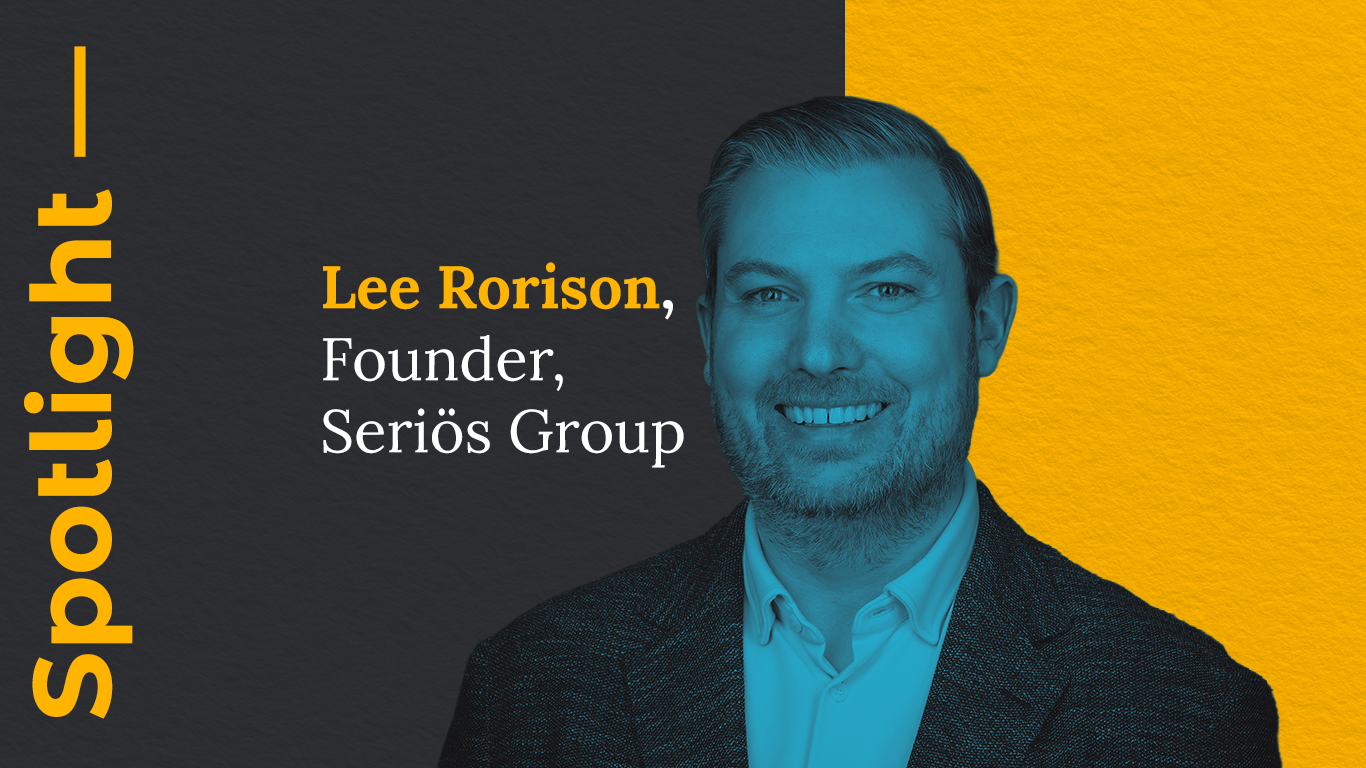
Long before artificial intelligence became the boardroom shorthand for reinvention, Lee Rorison had already formed a clear view of what was slowing data transformation down. Across years spent working in data solutions, business intelligence, and large-scale transformation programmes, he saw the same pattern repeat itself: ambitious projects, heavy delivery teams, long timelines, and too little clarity on when value would actually arrive.
By the time he founded Seriös Group in 2020, that frustration had hardened into a sharper conviction. The problem, as he saw it, was rarely a lack of technology. More often, it was the way data programmes were being designed and delivered — spread across multiple vendors, tied to time-and-materials models, and weighed down by process long before they produced useful outcomes. Seriös Group was built in direct opposition to that model, with Rorison setting out to create a business organised around pace, accountability, and measurable results.
His route into the sector had not been accidental. With a degree in Biochemistry and an MSc in Bioinformatics, Rorison entered the world of enterprise data with a strong technical base, then spent close to two decades working across complex environments where data platforms and warehouses sat at the centre of larger ERP and digital transformation programmes. Those years gave him a detailed view of what large organisations were trying to achieve, and of how easily those ambitions could become diluted once delivery began.
What emerged from that experience was less a rejection of consultancy than a rejection of consultancy that had lost sight of the end user. Organisations were investing heavily in data, yet too many were left navigating sprawling engagements that consumed time and money without delivering durable capability. Rorison’s answer was to strip the model back to fundamentals: begin with the outcome, remain open on technology, and reduce the distance between project start and business value.
That approach now runs through Seriös ONE, the company’s product-led delivery model, which sits at the centre of its five-year growth plan. The point is not simply speed for its own sake. Nor is it a pitch for one technology stack over another. Instead, the company has shaped its offer around a practical problem that continues to frustrate large organisations: fragmented systems, inconsistent data, and delivery models that ask for prolonged commitment before producing anything sufficiently robust to support decision-making. Rorison’s proposition is that strong data foundations, good governance, and usable outputs do not need to sit at the far end of a drawn-out consulting process.
That argument has found an audience. As organisations have accelerated their interest in analytics, automation, and AI, many have discovered that poor data quality, weak governance, and disconnected systems do not disappear simply because new tools arrive. In some cases, those weaknesses become more visible. Advanced analytics may promise sharper insight, but it still depends on whether the underlying data can be trusted. AI may offer speed, but it also exposes the cost of inconsistency. Against that backdrop, the appeal of a more disciplined, outcome-led model is easy to understand.
Seriös Group has expanded quickly on the strength of that proposition. The business, based in Hoults Yard in Newcastle, now works with clients across financial services, gaming, built environment, healthcare, retail, and technology, while its client roster includes Bank of Ireland, JLL, Northern Powergrid, True Potential, Vertu, Grainger plc, NHS Business Services Authority, and tombola. In 2025/26, the company recorded 53% growth and increased headcount from 55 to 63, a pace that has demanded as much from Rorison’s leadership as it has from the business model itself.
Growth of that sort changes the job of a founder. The qualities that help establish a business — intensity, direct oversight, instinctive decision-making, and close control over standards — rarely remain sufficient once the organisation becomes larger, more layered, and more commercially exposed. Rorison has had to adapt to that shift without loosening his grip on the principles that defined Seriös Group from the outset. Delegation, structure, and leadership depth become unavoidable once a business reaches a certain scale, yet those additions can also blunt what made a challenger brand effective in the first place if they are handled poorly.
His response has been to strengthen the leadership team while keeping quality at the centre of the company’s growth. Recent senior appointments across operations, finance, commercial leadership, and technology suggest a business preparing itself for a more mature phase of expansion, but they also reflect a founder willing to build beyond his own immediate span of control. That is often the harder part of scaling: not deciding to grow, but deciding how to grow without losing the sharpness of the original idea.
Inside the business, the same discipline can be seen in its approach to talent. Rather than chasing headcount as a signal of momentum, Seriös Group began with a deliberately small, high-quality team and invested early in graduates and emerging talent. That decision has given the business a different texture from consultancies that rely heavily on scale alone. It also points to a longer-term view of capability, one rooted in building sustainable data careers and creating an environment where people can work on complex, commercially relevant problems without being reduced to interchangeable delivery resource.
There is substance, too, in the company’s Newcastle base. Technology and data capability in the UK has long been discussed through a London lens, yet the growth of businesses such as Seriös Group says something about where expertise, ambition, and opportunity now sit. Hoults Yard is not simply an address in the story of the company; it is part of a broader regional confidence in building nationally relevant businesses outside traditional centres of gravity.
Rorison’s ambitions for the next five years remain expansive. Seriös Group is targeting national and international growth, planning to double turnover, grow the team significantly, and reach £20m in revenue by FY2030. Those targets are bold, although they follow a line already established in the company’s first years: build strong data foundations, shorten the path to value, and challenge the assumption that meaningful transformation must be slow, sprawling, and prohibitively expensive.
That view has shaped the business from the beginning, and it continues to set its tone now. Beneath the language of platforms, frameworks, and AI readiness sits a simpler idea, pursued with unusual consistency: data work should earn its place early, hold up under pressure, and remain tied to outcomes that can be seen, measured, and used.
This interview appeared in the Q2 edition of Business Quarter magazine. Subscribe for free to read the full magazine.