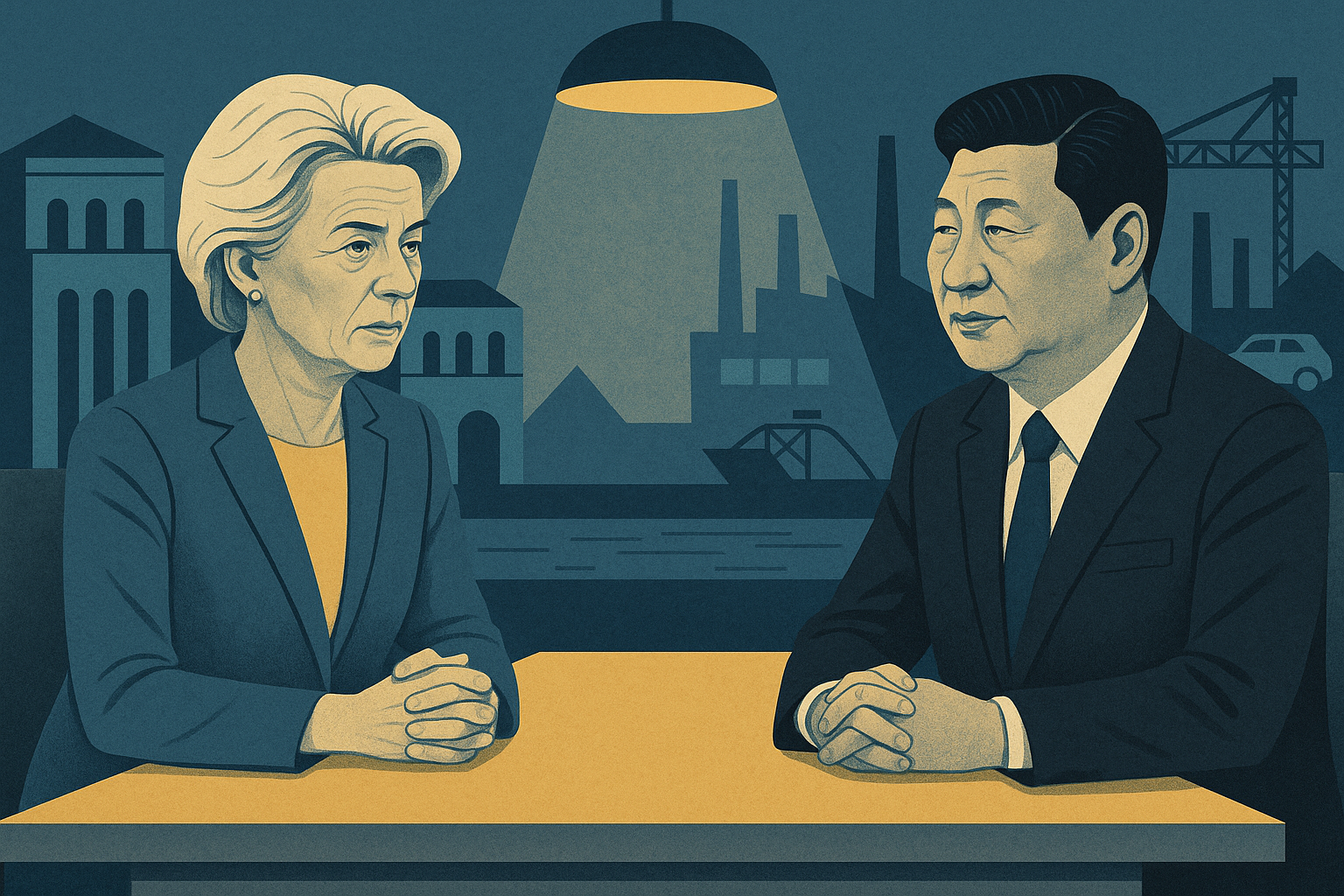
European Commission President Ursula von der Leyen warned that relations with China had reached an “inflection point” at a high-stakes one-day summit in Beijing, as EU leaders pushed for progress on trade imbalances, critical minerals, and Chinese industrial overcapacity.
The talks — originally planned for two days — were truncated after what Chinese officials called a “scheduling conflict,” reflecting modest expectations from both sides. Von der Leyen, joined by European Council President António Costa, called for an “essential” rebalancing of economic ties, while President Xi Jinping told the EU to “make correct strategic choices.”
Key issues included the EU’s €306 bn goods trade deficit with China, curbs on critical minerals, and existing duties of up to 37.6% on China-built electric vehicles (EVs). Discussions also touched on rare-earth exports and Beijing’s broader industrial policy. European leaders warned that unless market access improved, further countermeasures would follow.
The EU’s push for recalibration comes against a ticking deadline in transatlantic trade talks. Brussels is seeking a 15% tariff baseline with Washington to head off a 30% U.S. auto levy set for 1 August. The EU has prepared a €93 bn retaliation package if negotiations collapse — with China watching closely.
No major deliverables emerged from the summit, though joint language on climate cooperation remains possible. A planned business roundtable was moved to Beijing proper and demoted in prominence.
Europe’s reliance on China for critical materials remains a strategic pressure point. EU officials highlighted dependency figures — over 95% for rare earths and 98% for gallium — as justification for scrutiny. Meanwhile, China’s exports of rare-earth magnets surged 157.5% month-on-month in June after licensing backlogs eased, although year-to-date volumes remain down nearly 19%.
Industrial overcapacity is another unresolved flashpoint. The OECD estimates global steel overcapacity at around 644 mn tonnes in 2025, with China contributing more than 1 bn tonnes in 2023. The EU cites this as further evidence of market distortions, especially in sectors like EVs, solar panels, and base metals.
While Brussels insists it wants to “de‑risk, not decouple,” measures now in play — including anti-subsidy probes, digital market restrictions, and procurement curbs — suggest a steadily hardening stance. China, by contrast, continues to frame the relationship as one of stability and partnership, with official state media focusing on “constructive engagement.”
Markets responded positively to signs of coordination between Brussels and Washington. European auto stocks — including VW, BMW, and Stellantis — rallied on 23 July, helping lift the STOXX 600 to a two-week high amid growing bets that Europe could secure U.S.-style tariff exemptions.
Next steps for policymakers are critical. The EU’s definitive EV tariff measures are now in force, but the bloc has left open the door for revisions should Beijing offer verifiable concessions. Simultaneously, Europe must finalise its U.S. tariff agreement before the August deadline to avoid a fresh round of transatlantic friction.
As von der Leyen concluded in her opening remarks, the time to “advance and rebalance” is now. But with no breakthrough in Beijing and deadlines looming on multiple fronts, questions remain over how — and when — Europe’s recalibration will be realised.