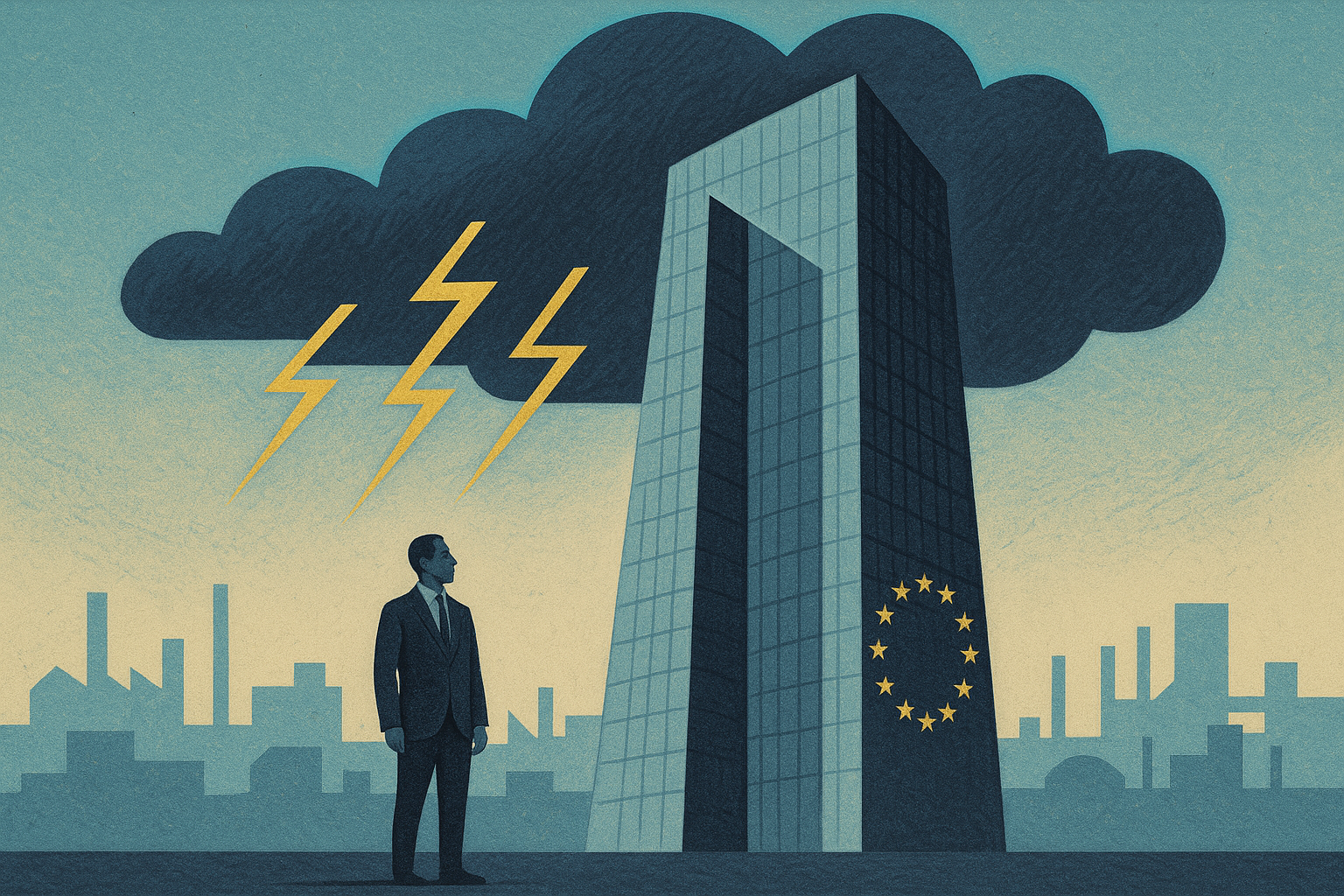
The European Central Bank (ECB) faces renewed market and policy uncertainty after U.S. President Donald Trump warned he will impose a 30% tariff on all European Union-origin goods from 1 August 2025 unless a new trade agreement is reached. The prospect of blanket duties — far exceeding any scenario previously modelled by ECB economists — has prompted Governing Council members to call for calm and signal a pause in the Bank’s rate-cut cycle.
Bundesbank President and ECB Governing-Council member Joachim Nagel, in an interview published on Tuesday, said the ECB needs “politics with a steady hand” as it navigates the risk of an escalating trans-Atlantic trade dispute. “In terms of monetary policy, politics with a steady hand is required right now,” Nagel said, adding that while the price impact of the U.S. tariff threat is “extremely uncertain”, there is “no immediate policy move” warranted at this stage.
The ECB had been widely expected to pause its rate-cut cycle at its 23–24 July meeting, with the deposit rate currently at 2%. While policymakers had assumed only a 10% tariff in earlier models, the prospect of a 30% flat duty — and a likely EU retaliation of similar scale — is now seen as steeper than even their worst‐case. ECB staff will rerun their forecasts ahead of the meeting, with some analysts estimating a combined tariff rate could shave up to 0.7 percentage points from euro-zone growth and push the deposit rate down to around 1% by March 2026.
Brussels, meanwhile, has drafted a €72 bn counter-tariff list targeting U.S. aircraft, autos, bourbon, and other goods, pending approval from EU member states. European Trade Commissioner Maroš Šefčovič described the proposed 30% rate as “practically prohibitive”, warning it would be “almost impossible to continue trade as we are used to in a trans-Atlantic relationship.” German Chancellor Friedrich Merz also cautioned that “it would hit the export industry to the core,” threatening both growth and government fiscal plans.
The tariff threat has already shaken markets. The euro weakened to $1.05 on Tuesday, while German 10-year bund yields fell by around 9 basis points on safe-haven flows. EU goods exports to the U.S. were €553 bn last year, contributing to a €235 bn U.S. deficit — a figure repeatedly cited by the White House in justifying the move. German think tank IW has warned that tariffs in the 20–50% range could cost Germany alone over €200 bn in GDP through 2028.
ECB policymakers are now under pressure to balance the risk of a tariff-induced growth shock with inflation that remains close to 2%. The next Governing Council meeting is set to provide fresh staff projections and a clearer sense of whether the Bank will stay its course, or be forced into a faster easing cycle if trade tensions continue to escalate.