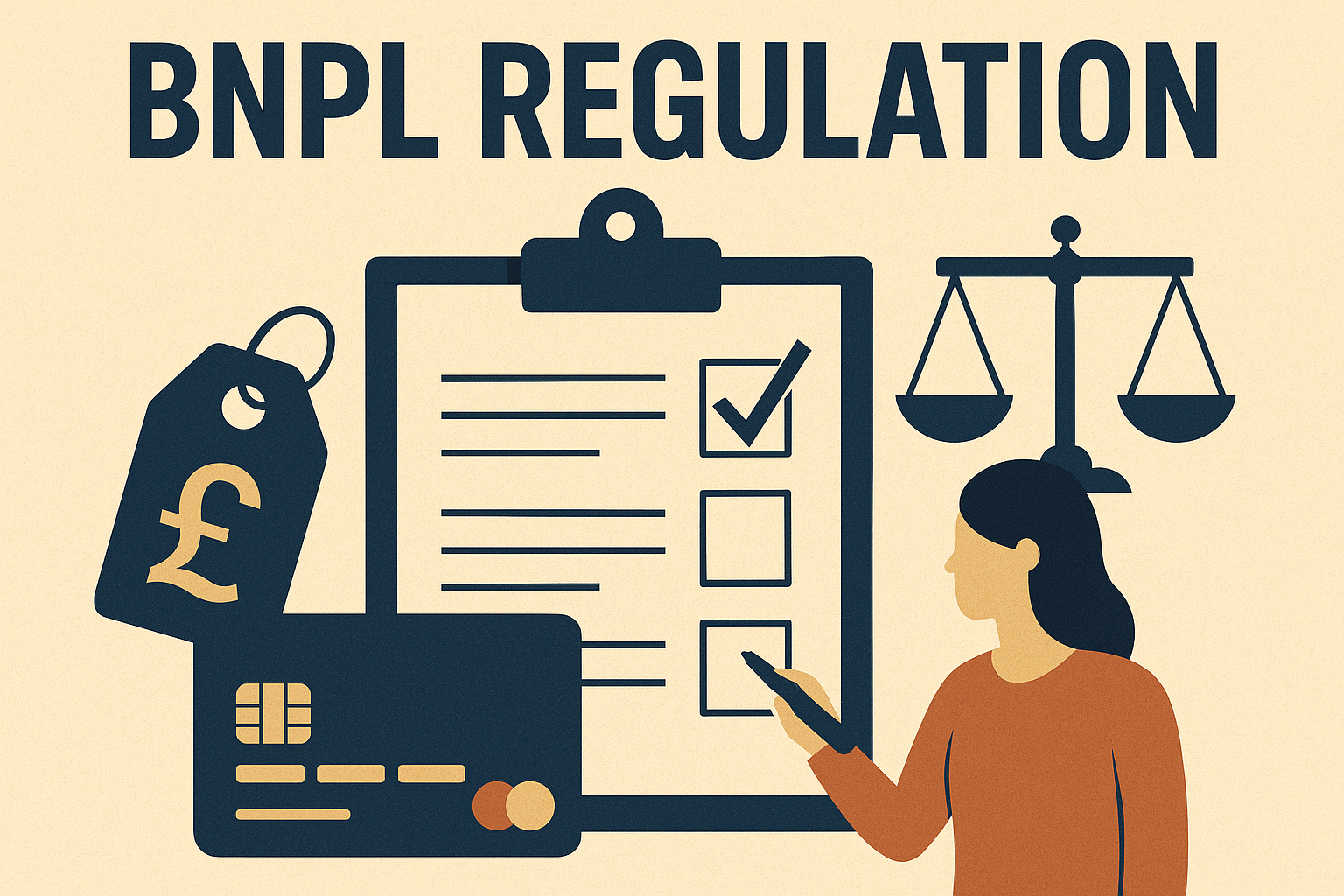
The UK government has confirmed plans to regulate buy now, pay later (BNPL) products under the Consumer Credit Act, marking a turning point for one of the most influential segments in consumer fintech. The proposals — first hinted at nearly three years ago — will introduce mandatory affordability checks, accelerated refund rights, and access to the Financial Ombudsman. Providers will also require full FCA authorisation.
The move ends a prolonged regulatory vacuum in which BNPL firms operated with near impunity while capturing a growing share of UK retail credit. Used by an estimated 11 million people, the model has enabled rapid expansion by offering short-term, interest-free finance with limited friction — but often without the disclosures or protections typical of credit products.
For operators like Klarna, Clearpay and Zilch, the shift will bring compliance overheads and tighter constraints on user acquisition. Klarna, the category leader, has signalled support for “proportionate regulation” and already implements internal checks. However, analysts warn the broader market — especially smaller, marketing-led players — may struggle to adapt. Liberum has forecast that FCA supervision could reduce BNPL margins by 2–3 percentage points, with possible consolidation on the horizon.
The regulatory framework aligns the UK with emerging standards across major economies. Australia has passed similar laws, while the EU and US have introduced tighter supervision under financial stability mandates. The UK Treasury had faced growing criticism for lagging behind its peers — particularly given BNPL’s popularity among younger consumers and the sector’s role in driving unsecured debt.
For retailers, the shift introduces uncertainty. BNPL has often been embedded at checkout as a conversion tool, with merchants benefiting from higher basket sizes and lower cart abandonment. Tighter affordability checks and stricter advertising rules may reduce uptake, or slow transaction flow at the point of sale.
Investors, meanwhile, face a recalibration. BNPL valuations were buoyed by a growth-at-all-costs narrative — one now tempered by the realisation that regulation is no longer a matter of “if”, but “how soon and how hard”. With full implementation not expected until 2026, firms have a window to adapt business models and demonstrate regulatory readiness to capital markets.
At a broader level, the UK’s decision reflects a maturing view of fintech — one that sees it not as a disruption to be indulged, but as a financial actor to be governed. The BNPL boom may have rewritten the playbook for short-term credit, but the rules are now catching up. For operators, the next chapter will be shaped as much by regulatory fluency as much as product design or user experience.